


Las Vegas Hosts Its Fourth Grand Prix With a World Champion Already Decided
By the time the Formula 1 field arrives at Harry Reid International Airport this week, the 2026 World Drivers’ Championship is already settled. Kimi Antonelli clinched it in Mexico City, became the youngest world champion in the sport’s modern era, and arrived in Las Vegas with Mercedes also having secured the constructors’ title — their ninth — in the same afternoon. The championship math is complete. November 22 is not a coronation. It is a race.
That distinction matters more than it might seem at first. Some of the most memorable Formula 1 races in recent history have been run in exactly this condition, when the pressure of a points race is gone and what remains is pride, pace, and the specific hunger that professional athletes carry when they have nothing to lose. Las Vegas in 2024 produced a Verstappen win over a soaking wet grid in conditions that required timing and nerve rather than just speed. Las Vegas in 2025 produced another Verstappen win, this one over George Russell. This year the question is whether Max Verstappen becomes the first driver to win three consecutive Las Vegas Grand Prix.
He has been trying to do it in a Red Bull that has been decidedly un-dominant for most of the 2026 season. Three wins, twelve podiums, and a points total that placed him second in the championship behind Antonelli. The car that won five consecutive constructors’ titles between 2021 and 2023 has been competitive rather than dominant, and Verstappen’s ability to extract results from machinery that is not definitively the fastest on the grid has been, as it usually is, the most honest demonstration of his driving ability.
A Street Circuit Built for Spectacle
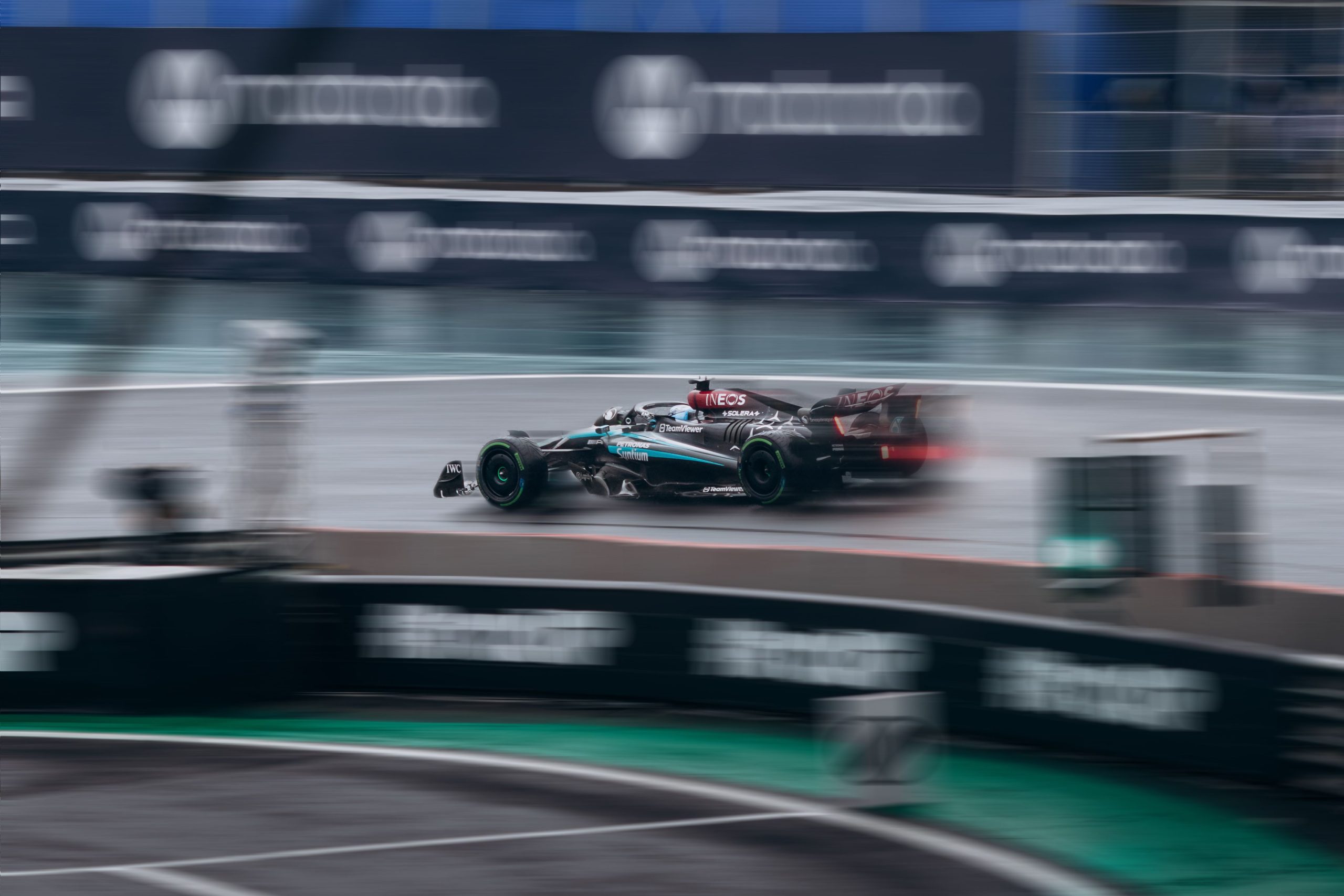
The Las Vegas Grand Prix circuit runs 6.12 kilometers through some of the most expensive real estate in the American West. The grid assembles near the Bellagio fountain with the Strip’s compressed skyline at their backs, and the cars reach speeds approaching 342 kilometers per hour on the longest straight before braking hard into a chicane that separates the fast from the reckless. The race is 50 laps, approximately 306 kilometers, run under the desert night sky at temperatures that challenge every assumption tire engineers carried in from the European rounds.
Cold is the operative technical word. November nighttime temperatures in Las Vegas hover between 10 and 14 degrees Celsius during the race window, and those temperatures do what cold always does to tire compounds: they narrow the working range, extend the time required to bring tires into proper operating temperature, and punish any driver who pushes too hard on an underheated tire in the opening laps. The Las Vegas pit lane has become, over three years of this race, one of the more sophisticated tire management exercises on the calendar. Teams that arrive with the right compound selection and the patience to cycle through the temperature window correctly gain measurable time over teams that go hunting for grip that the conditions will not provide.
The night-racing atmosphere adds a dimension that television does not fully capture. The Strip’s perpetual luminescence creates a backdrop that is visually unlike anything else on the Formula 1 calendar, the billboards and hotel facades casting light across the racing surface in a way that makes the whole event feel like something assembled from sports and entertainment in roughly equal measure. For the fourth consecutive year, more than a hundred thousand people will watch twenty cars run fifty laps around the same blocks where hotel guests are, three nights a week, watching Adele.
Verstappen, Norris, and the Battle That the Championship Cannot Provide
The championship may be decided but the inter-team competition is not. Lando Norris won the Sao Paulo Grand Prix last week, his third win of the 2026 season, and his McLaren has been a faster car through the final stretch of the calendar than anyone outside the McLaren camp would have predicted at the season’s midpoint. The upgrade McLaren brought to the Japanese Grand Prix in October changed the competitive calculus in a way that the mid-season standings had not indicated. Norris arrives in Las Vegas with momentum, a car that is peaking at exactly the right time, and the specific motivation of a driver who wants to end the season having made a statement about where McLaren sits for 2027.
Ferrari and Lewis Hamilton sit in a complicated position. Hamilton moved from Mercedes to Ferrari at the start of 2024, a decision that generated more coverage than perhaps any driver transfer in the sport’s history, and his two seasons at Ferrari have been a story of a team and a driver still learning how to get the best from each other. His Las Vegas performance will be watched for different reasons than Norris and Verstappen. Hamilton brings an American commercial gravity to this particular race that is distinct from what any other driver on the grid brings — his visibility in the American market, his relationships in entertainment and fashion, and the specific symbolic weight of a driver who grew up in a sport that was largely invisible in America now competing on a circuit named after the country’s most concentrated entertainment economy.
George Russell, also at Mercedes, represents the defense of a constructors’ title on a circuit where Mercedes won last year. His task is different from Verstappen’s: he is trying to demonstrate that the dominant car in a dominant season is also the right car for the specific demands of this street circuit.
What the Strip Gives Up for Race Week
Before discussing what happens on the circuit, what the city gives up to run this event deserves its own accounting. The road closure footprint for the Las Vegas Grand Prix is not incidental. It is structurally transformative for the neighborhoods adjacent to the circuit. The Koval Lane and Flamingo Road intersection, which carries approximately 50,000 vehicles per day under normal conditions, has been under full closure since mid-October for circuit infrastructure installation. The southbound Las Vegas Boulevard near Bellagio was closed through early November. The Flamingo bridge over Las Vegas Boulevard, necessary for race infrastructure, required a full installation period that displaced traffic onto alternate corridors for weeks.
The business impact is documented and ongoing. Mohit Singh, who manages Las Vegas Souvenirs and Gifts at the Flamingo and Koval location, has described the revenue losses during the closure period as severe. His store depends on the pedestrian and vehicle traffic generated by one of the busiest intersections in the country. When that intersection disappears for six weeks, the revenue disappears with it. His situation is representative of dozens of small businesses within the closure zone whose economics are directly tied to the foot traffic that race infrastructure eliminates.
The larger hospitality economy tells a different story. The Grand Prix week hotel rates in Las Vegas are among the highest of any single-event week on the American entertainment calendar. The race has generated a cumulative $3.2 billion in economic impact since its 2023 debut, and the LVCVA and Clark County committed to a 10-year extension through 2037 based on that trajectory. The two economies, the small businesses within the closure zone and the Strip properties whose occupancy and room rates the race drives, are both real and both sit inside the same event.
The Case Formula 1 Has Made in Las Vegas
Three races in, the Las Vegas Grand Prix has demonstrated something that was not obvious when the first race week infrastructure went up in 2023: American audiences, specifically the cross-section of entertainment consumer and sports fan that Formula 1 has been cultivating since Drive to Survive, will pay premium prices for a premium experience and they will continue to do it. The 2025 race sold out. The 2026 race sold out earlier. The 10-year extension was not a speculative bet on a market that might develop. It was a recognition of a market that had already developed.
The race’s demographics reflect a broader shift in how Formula 1 markets itself in the United States. The drivers are younger. The presentation is heavier on personality and narrative and lighter on pure technical discussion. The Las Vegas Grand Prix specifically uses the Strip backdrop as a full collaboration between the sport and the entertainment economy rather than as a neutral venue. Those choices have produced an event that sells out and that has built a fan base that now has three years of Las Vegas race weeks as a tradition rather than a novelty.
The sport signed a 10-year extension with Clark County and the LVCVA securing the race through 2037. The commitment from LVCVA runs approximately $20 million as the publicly documented portion of the arrangement. What that commitment purchases is a race that Clark County and the broader Las Vegas tourism economy now relies on as one of the marquee events on its annual calendar.
The Tire Problem Nobody Talks About Enough
Formula 1 coverage tends to emphasize driver battles and strategic decisions in a way that obscures the fundamental constraint that shapes both: tire performance. In Las Vegas, that constraint is tighter than almost anywhere else on the calendar, because the temperature window is so specific. Pirelli brings its hardest compound allocations to Las Vegas precisely because the nighttime temperatures and the high-speed nature of the circuit demand a tire that can survive both the extended operating time and the peak loads of the Strip straight without degrading catastrophically.
The teams that figure out tire preparation fastest in qualifying and in the opening race laps gain an advantage that compounds. A car whose tires are in the working range from lap one can push where others cannot. A car that is still warming its tires through the first sector is managing rather than attacking. Over fifty laps, the difference between a team that solves the tire puzzle on Friday and one that solves it on race day is measured in multiple seconds and potentially multiple positions.
This particular technical challenge has historically favored the more experienced engineering departments with deeper data sets from prior Las Vegas editions. Red Bull, Mercedes, and Ferrari each have three years of Las Vegas tire data. The teams with less institutional memory of this circuit’s specific demands start the weekend with a narrower information base, and in a race where the margins are measured in tenths, the depth of institutional knowledge carries measurable weight.
Notes for Stakeholders
The Las Vegas Grand Prix’s commercial and civic significance extends well beyond the race result:
The 10-year extension through 2037 means that every major capital investment decision tied to the race corridor, hotel infrastructure along the Strip, Brightline West’s Las Vegas terminus, the Bally’s resort development on the former Tropicana site, is being made against a backdrop of a guaranteed annual race week that creates an economic multiplier for that entire corridor. Developers and investors pricing Las Vegas assets on the Strip now include the Grand Prix week as a known, recurring premium event.
The small business impact within the closure zone is a governance question the new administration will inherit. Governor-elect Aaron Ford has not addressed Grand Prix closure policy specifically, but his emphasis on the gap between the macro economy and the household and small business economy describes exactly the dynamic at play in the Flamingo-Koval corridor during October and November.
Formula 1’s commercial partnership with American media — ESPN holds the domestic broadcast rights — means that the Las Vegas race is the last American race of the 2026 season and the most commercially significant from a U.S. television perspective. The audience numbers from Las Vegas consistently exceed those from Austin and Miami, the other American rounds, which reflects both the Strip’s visual appeal and the event’s place in the late-season calendar.
Lewis Hamilton’s commercial value in the Las Vegas market is a separate category from his racing value. His presence at Ferrari has not produced a championship but it has produced consistent engagement from an American audience that follows his public persona as closely as his lap times. For Formula 1’s American commercial strategy, that matters.
Fifty Laps Under the Lights
The race starts on the night of November 22. Twenty drivers, twenty cars, the Strip lit up behind them, and fifty laps of a street circuit that has produced three years of competitive racing. The championship is settled. The constructors’ title is settled. The question on Saturday night is simply who crosses the line first.
Verstappen wants a third consecutive Las Vegas win on a circuit he has figured out in a way that a driver who has won back-to-back rarely fails to reference. Norris wants to close a season that ended stronger than it began with another result that tells the paddock something about McLaren’s 2027 trajectory. Antonelli wants to win the race in which he is the champion, because that is the kind of moment that defines a driver’s first title season in the memory of the sport.
The cold will slow tire warmup. The long straight will tax brakes and engines at the limits of their design. The chicanes will separate the brave from the calculating. And 100,000 people in the stands, and millions watching on television, will watch all of it unfold in the most theatrically American setting the sport has ever found.
Key Takeaways:
- The 2026 Las Vegas Grand Prix runs November 22, the fourth edition of the race; both the World Drivers’ Championship (Kimi Antonelli, Mercedes) and the Constructors’ Championship (Mercedes, their ninth) were clinched at the Mexico City Grand Prix before this race weekend, leaving individual race victory and end-of-season positioning as the competitive stakes
- Max Verstappen won the 2024 and 2025 Las Vegas Grand Prix and seeks to become the first driver to win the race three consecutive times; his 2026 season produced three wins and twelve podiums in a Red Bull that has been competitive but not dominant
- Lando Norris won the Sao Paulo Grand Prix the week before Las Vegas, his third win of 2026, and his McLaren has shown significant late-season performance improvement following a major upgrade package introduced at the Japanese Grand Prix in October
- Lewis Hamilton, in his second season at Ferrari following his high-profile move from Mercedes before the 2024 season, brings specific American commercial significance to the Las Vegas race given his visibility and fan base in the U.S. market
- The circuit runs 6.12 kilometers through the Strip at speeds approaching 342 kilometers per hour on the main straight; nighttime temperatures between 10 and 14 degrees Celsius create a narrow tire operating window that shapes race strategy and separates teams with deep Las Vegas data from those without it
- Pirelli supplies its hardest compound allocations to Las Vegas because the combination of cold temperatures and high-speed demands requires tires that can survive extended heat cycles; teams that solve the tire preparation challenge on Friday qualifying night carry a compounding advantage across the 50-lap race
- Road closures for race week infrastructure have been active since mid-October, with the Koval Lane and Flamingo Road intersection closed from normal operations; the closure carries a documented economic impact on small businesses within the zone that depend on the intersection’s 50,000 daily vehicles
- Formula 1 signed a 10-year extension with Clark County and the LVCVA securing the race through 2037; the LVCVA’s publicly documented commitment is approximately $20 million, and the race has generated a cumulative $3.2 billion in economic impact since its 2023 debut
- The 2025 race sold out and the 2026 race sold out earlier; the Las Vegas round consistently produces the highest U.S. television audience of the three American Grand Prix weekends (Austin, Miami, Las Vegas), reflecting both the Strip backdrop and the race’s late-season calendar position
- The 10-year extension means major capital investment decisions across the Strip corridor, including the Bally’s resort development and Brightline West’s Las Vegas terminus, are being priced against a guaranteed annual race week premium event through at least 2037