


Spring Mountain Road in Las Vegas does not need another restaurant concept. The Chinatown corridor running west from the Strip is already one of the most dense and diverse dining streets in America, stacking Korean BBQ houses, Vietnamese noodle shops, dim sum parlors, Japanese ramen bars, and Taiwanese snack spots into a stretch of road that serious eaters travel specifically to explore. The competition is relentless. New concepts arrive, struggle, pivot, or close with regularity. Surviving here requires more than decent food.
That context makes what the Chubby Group has built on Spring Mountain Road over the past few years genuinely interesting. They already operate Chubby Cattle BBQ, an all-you-can-eat yakiniku concept, in Suite 106 at 4525 Spring Mountain Road. In June 2026, they opened Chubby Skewers directly next door in Suite 105, bringing Dongbei-style grilled skewers to a corridor where Japanese and Korean BBQ formats already have deep roots.
The decision to cluster concepts in adjacent suites rather than scatter them across the valley reflects deliberate thinking about how restaurant brands build operational strength and neighborhood identity. It also reflects confidence in a cuisine category, Dongbei-style street food from northeast China, that remains unfamiliar to many Las Vegas diners despite its enormous popularity across China and within Chinese-American communities on the West Coast.
Understanding what Chubby Skewers is serving, why the Chubby Group expanded in this specific direction, and what the opening signals about the evolution of Las Vegas Chinatown requires looking at all three elements together.
What Dongbei Actually Is
Northeast China, the region historically known in the West as Manchuria, encompasses the provinces of Heilongjiang, Jilin, and Liaoning. The food of this region differs significantly from the Chinese cuisines most Americans encounter. It’s not the delicate steamed preparations of Cantonese cooking. It’s not the numbing heat of Sichuan. It’s not the seafood-forward freshness of Fujian or the vinegar-bright sharpness of Shanxi.
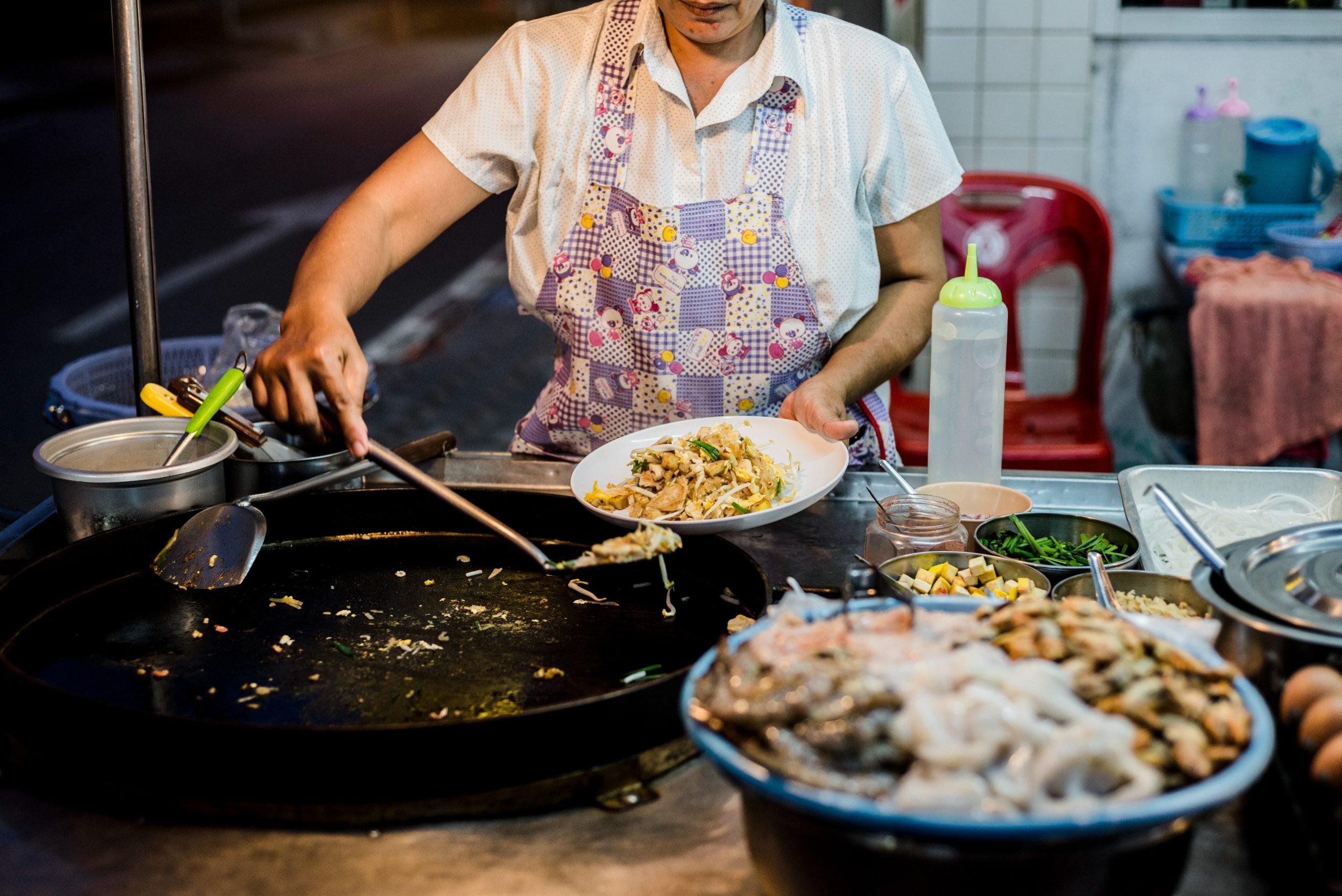
Dongbei cooking comes from a cold-climate agricultural and nomadic heritage. The dishes are hearty, often smoky, frequently intense in flavor, and built for communal eating. Grilled meats on skewers, sold from street carts in markets and back alleys, represent one of the tradition’s most beloved expressions. Vendors set up with charcoal or gas grills, lay out trays of marinated meats and vegetables on skewers, and cook to order while customers drink beer and eat standing up or at low tables.
The skewers themselves cover remarkable range. Lamb, which dominates in many northern Chinese grilling traditions, appears alongside beef, pork belly, chicken wings, and seafood. Wagyu beef shows up at quality-focused operators. Duck tongue, a delicacy that challenges Western comfort zones while delivering genuinely complex texture, sits in the trays alongside purple sweet potato, shiitake mushrooms, and tofu that crisps beautifully over direct heat.
Cold dishes accompany the grilled items. Spicy cold noodles, dressed with sesame, chili oil, and vinegar, provide textural contrast. Sizzling tofu arrives at the table still popping. The overall eating pattern is grazing and sharing rather than individual courses, with skewers arriving continuously as groups work their way through selections.
This format is deeply social, intrinsically designed for groups, and built around the pleasure of watching food cook rather than waiting for it to arrive plated. Understanding why this works in Las Vegas requires recognizing that these social dynamics are exactly what the city’s dining culture has been trying to manufacture with increasingly elaborate tableside presentations and theatrical service.
The Chubby Group Portfolio Logic
The Chubby Group’s Las Vegas presence spans multiple concepts that fit together more coherently than they might initially appear. The original Chubby Cattle BBQ on South Jones Boulevard established the brand’s identity in the Korean-influenced all-you-can-eat BBQ format. Mikiya Wagyu Shabu House on Spring Mountain brought premium Japanese hot pot. The X Pot inside The Venetian placed a high-tech, experiential hot pot concept in the heart of the Strip.
Each of these concepts shares underlying structural similarities. They’re all formats where communal cooking happens at the table. The customer participates in preparation rather than receiving finished dishes from an invisible kitchen. The social dynamic of cooking together and sharing drives the experience as much as the food itself. And each concept targets a different price point and audience, from the accessible all-you-can-eat format to the premium Strip location.
Chubby Skewers fits this portfolio logic precisely. The grilled skewer format is the street food equivalent of the tabletop cooking concepts already in the portfolio. It’s more casual, more accessible, and more explicitly tied to Chinese street culture rather than Japanese or Korean restaurant traditions. And at skewer prices starting at $1, it occupies a price tier that the rest of the portfolio doesn’t serve.
The clustering of Chubby Cattle BBQ and Chubby Skewers in adjacent suites on Spring Mountain creates operational efficiencies that independent restaurants cannot match. Shared receiving and storage. Cross-training potential for staff. The ability to direct overflow from one concept to the other on busy nights. And the combined presence creates a Chubby Group block identity on a street where standing out requires more than just a sign.
The Back-Alley Aesthetic as Design Philosophy
Chubby Skewers’ interior design is worth examining as a business decision rather than just an aesthetic choice. The restaurant deliberately channels the energy of a back-alley Chinese barbecue joint: neon lighting, bold reds and yellows, low tables, industrial-meets-street-market atmosphere. This design communicates something specific to different customer segments.
For Las Vegas diners familiar with Chinese street food culture, either through travel or through West Coast Chinese-American food scenes, the aesthetic creates immediate recognition and comfort. It signals authenticity rather than assimilation, telling these customers that what’s served here won’t be adjusted for unfamiliar palates.
For Las Vegas diners encountering Dongbei-style BBQ for the first time, the same aesthetic communicates adventure and distinctiveness. This doesn’t look like the polished Chinese restaurants that line the corridor. It looks like somewhere with a story, somewhere that makes specific choices rather than trying to appeal to everyone.
The late-night hours, running from 5 p.m. to 3 a.m. on weekdays and 4 p.m. to 3 a.m. on weekends, reinforce this positioning. Back-alley barbecue culture in China is explicitly nocturnal. The best sessions happen after midnight, when day workers and night owls find common ground over cold beer and rotating skewers. Las Vegas, with its 24-hour hospitality economy and late-night dining demand that few other American cities match, is one of the only markets in the country where this schedule makes complete operational sense.
Running until 3 a.m. in a city where casinos and entertainment venues generate foot traffic at 2 a.m. creates access to a customer segment that most restaurants never see. The late-night economy on Spring Mountain, already established through other Chinatown restaurants that run similar hours, gives Chubby Skewers a built-in audience that doesn’t require building from scratch.
The $1 Skewer Strategy
Pricing skewers starting at $1 represents a decision that shapes everything about Chubby Skewers’ market position and customer experience. At $1 per skewer, the concept is accessible to an enormous range of customers. Groups can order liberally without calculating whether they’re overspending. First-time visitors can try duck tongue or wagyu without the commitment anxiety that higher prices create. And the $1 entry point drives trial volume that builds word-of-mouth faster than premium pricing ever could.
But the math requires examination. At $1 per skewer, the revenue per item is minimal. The business model works only if average checks reach meaningful totals through volume, if add-on items like cold dishes and beverages carry higher margins, and if the self-service skewer bar model keeps labor costs in line with the low per-item pricing.
The semi-self-service model addresses the labor question directly. Rather than servers taking individual skewer orders and managing complex coursing across multiple tables, guests select from the skewer bar and bring their choices to the grill. This shifts labor toward grill operation rather than order-taking, which matches the street food spirit while keeping staffing ratios manageable at the price point.
The Chubby Club membership, offering skewers at $1 for a $58 annual fee or $28 annual fee depending on tier, creates recurring revenue and loyalty infrastructure that casual dining rarely builds. Members who pay annual fees feel invested in using the concept regularly, generating repeat visits that build neighborhood identity more effectively than one-time trial visits.
Wagyu beef and premium seafood items price above the $1 floor, allowing guests who want luxury within the casual format to find it. A table that mixes $1 cold noodles and $1 tofu skewers with $4 wagyu skewers reaches an average check that works for the business while still feeling accessible relative to most Las Vegas dining.
The Chinatown Effect
Spring Mountain Road’s success as a dining destination creates both advantages and challenges for new concepts. The advantage is concentrated foot traffic from diners who arrive specifically to eat, not just to pass through. Someone driving to Spring Mountain on a Friday night is already in a restaurant-going mindset, already prepared to spend money on food, already likely to try something new if the exterior presentation catches their attention.
The challenge is that same concentration creates comparison pressure. If Chubby Skewers is on a block with excellent Korean BBQ, excellent Japanese ramen, and excellent Vietnamese pho, it needs to deliver on its specific promise rather than competing across categories. Diners who know the street well will evaluate Chubby Skewers as a Dongbei specialist, not as a general Asian restaurant. This raises the authenticity requirement while also defining a clearer competitive position.
The Chubby Group’s existing presence on the street helps navigate this dynamic. Customers who trust Chubby Cattle BBQ arrive at Chubby Skewers with positive brand associations already established. The barrier to trial is lower when the operator’s name carries credibility from an adjacent space.
Las Vegas Chinatown continues expanding westward along Spring Mountain and into parallel corridors, with new openings appearing regularly across Chinese regional styles, Korean formats, and Japanese concepts. This growth suggests that the market can absorb continued additions when concepts are executed with sufficient specificity and quality.
Notes and Key Takeaways
For Restaurant Operators:
The Chubby Group’s strategy of clustering concepts in adjacent spaces demonstrates how multi-unit operators can build neighborhood identity and operational efficiency simultaneously. The shared location creates more value than two geographically separate concepts would generate at the same total investment.
For Diners:
Chubby Skewers offers genuine Dongbei-style Chinese street barbecue in Las Vegas Chinatown, a cuisine category rarely found outside major Chinese-American communities on the West Coast. The $1 starting price and late-night hours make it particularly suited for groups looking for extended casual dining experiences rather than quick formal meals.
For Las Vegas:
The opening of Chubby Skewers adds Dongbei-style Chinese barbecue to a Chinatown corridor that already represents one of America’s most diverse Asian dining districts. The continued depth of specialty Chinese regional cuisines on Spring Mountain positions Las Vegas as a serious destination for Chinese food that extends far beyond the generic Chinese-American formats available in most American cities.
Important Insights:
The late-night operating hours, running until 3 a.m. daily, give Chubby Skewers access to a customer segment that daytime and early-evening concepts never reach. In Las Vegas specifically, the post-midnight dining population is substantial and underserved by concepts that close at 10 or 11 p.m.
Dongbei cuisine’s relative unfamiliarity in Las Vegas creates first-mover advantage similar to what Guerrilla Pizza captured with Detroit-style. Being the recognizable name in an emerging category is worth more than being one excellent option in a crowded one.
The semi-self-service skewer bar model aligns labor investment with the format’s street food spirit while managing costs at a price point where conventional table service would require margins that don’t work. This operational efficiency is a feature rather than a compromise.
The Chubby Club membership structure builds recurring revenue and customer loyalty in a category where individual check averages are intentionally kept low. Annual fee payers who commit to the membership become regular visitors rather than occasional ones, providing business stability that high-price concepts with infrequent repeat visits lack.
Duck tongue as a menu item signals authenticity to Chinese diners while creating curiosity-driven trial among adventurous non-Chinese diners. Items that feel familiar within one cultural context and adventurous within another serve dual marketing purposes simultaneously.
The adjacency to Chubby Cattle BBQ creates competitive advantages that extend beyond operational efficiency. Guests who arrive for yakiniku and notice the new concept next door become immediate trial prospects. And groups with varying appetites can split between concepts while remaining in proximity, serving different preferences within a single dining occasion.
The back-alley aesthetic, rather than trying to elevate or Americanize the Dongbei street food tradition, commits to authenticity in ways that resonate with the increasingly sophisticated Spring Mountain dining community. Diners who seek out specialty cuisines on this corridor are exactly the audience that rewards commitment over compromise.
The $1 entry price creates social media sharing dynamics that premium concepts cannot generate. People photograph and share $1 items partly because the price itself is remarkable in Las Vegas context. This organic documentation drives awareness at no cost to the restaurant beyond the food itself.