

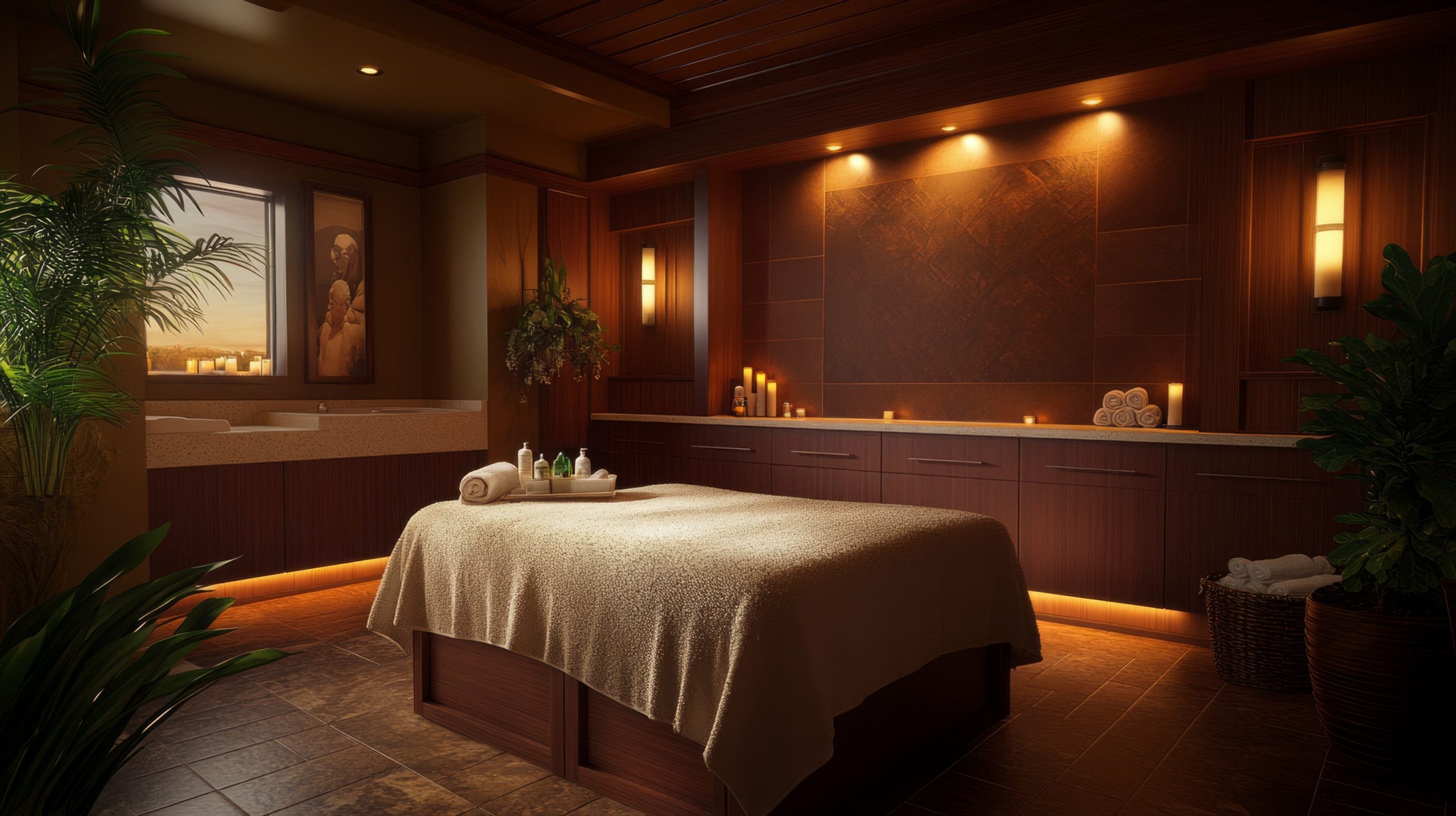
On June 25, 2026, South Point Hotel, Casino & Spa reopened the first phase of a multi-month renovation project: a redesigned salon featuring Esmeralda Green marble, walnut cabinetry, and brass accents in a space that previous guests would barely recognize. The full spa, including private treatment rooms, a relaxation lounge, steam rooms, sauna facilities, and an entirely new state-of-the-art fitness center, is scheduled to follow in fall 2026.
This is not a Strip megaresort unveiling a billion-dollar nightlife complex. South Point sits roughly seven miles south of the Strip on Las Vegas Boulevard, owned by veteran casino operator Michael Gaughan, built around a customer base that the property’s own marketing describes as locals and visitors seeking affordable luxury. The renovation represents a meaningful capital commitment, but not the kind that generates eight-figure headlines or motorcycle stunts over fountains.
And that is exactly why it matters. South Point’s spa investment offers a window into a different, quieter, and arguably more durable segment of the Las Vegas hospitality economy than the headline-grabbing Strip developments we have spent most of this series examining.
The Locals Casino Business Model, Briefly Explained
We have previously examined how Strip properties are increasingly courting Las Vegas residents through Monday night programming, free parking incentives, and integrated promotions. South Point represents the other side of that coin: a property built from the ground up to serve locals as the primary customer rather than as a secondary market to be activated during slow periods.
Locals casinos like South Point, Red Rock Resort, and the various Station Casinos properties operate on fundamentally different economics than Strip resorts. They depend on repeat visitation from residents who live within a reasonable driving distance, rather than one-time visits from tourists who may never return. This creates a business model that prizes consistency, value, and amenity breadth over spectacle and novelty.
The amenity list at South Point reflects this orientation directly: over 2,200 slot and video poker machines, more than 60 table games, 11 restaurants, a 400-seat showroom, a 640-seat Bingo room, a 16-screen Cinemark movie complex, a 64-lane bowling center, and one of the finest equestrian event facilities in the country. None of this reads like a property chasing international tourists. It reads like a property building a comprehensive entertainment and lifestyle destination for people who might visit weekly or even daily.
The spa and salon fit naturally into this ecosystem. A guest who bowls on Tuesday, sees a headliner show on Friday, and brings the family to watch a movie on Sunday is exactly the kind of customer who will also want a quality salon experience and an accessible fitness center without driving to the Strip or paying Strip prices.
Why the Salon Opened First
The phased rollout, salon in summer, full spa in fall, reflects a deliberate sequencing decision rather than simply a function of construction timelines.
Salons generate revenue through frequent, recurring visits. Hair appointments, manicures, and pedicures are services that many customers schedule on a weekly or biweekly basis. A spa’s massage and skincare treatments, by contrast, tend to be less frequent, often monthly or for special occasions. By opening the salon first, South Point activates its highest-frequency revenue stream as quickly as possible while the more capital-intensive and construction-heavy spa components, steam rooms, saunas, private treatment rooms, continue development.
This sequencing also allows South Point to begin rebuilding its service-based clientele and staff training processes before the more complex spa opening. Salon stylists and technicians can be hired, trained, and serving customers months before the spa’s wellness staff need to be fully operational. The phased approach reduces the risk of opening an entire renovated facility simultaneously and discovering operational gaps across multiple service categories at once.
The renovated salon’s Western-inspired design elements, incorporated alongside contemporary marble and brass finishes, also signal something about how South Point thinks about its brand identity relative to Strip competitors. The property is not trying to disguise its identity as a Western-themed, locals-oriented casino. It is incorporating that identity into a genuinely upgraded, luxury-adjacent space rather than abandoning it for generic international five-star design language.
The Affordable Luxury Positioning
General manager Ryan Growney’s statement that the new spa is a true reflection of South Point’s promise to deliver an unmatched experience deserves examination in the context of pricing strategy.
Affordable luxury is a meaningfully different value proposition than the premium positioning we examined with Legacy Club at Circa, which leans into exclusivity and high price points to attract a specific affluent clientele. South Point’s spa, even with genuinely upgraded materials and design, is being positioned to remain accessible to the property’s existing customer base rather than pivoting toward a more exclusive, higher-margin segment.
This distinction matters because it reflects different underlying business strategies. Circa is explicitly chasing affluent adults willing to pay premium prices for a curated, somewhat exclusive experience. South Point is reinvesting in amenity quality while maintaining accessibility for a broader local customer base that values consistency and good value over exclusivity.
Both strategies can succeed, but they require different execution. South Point’s challenge is ensuring that quality improvements do not come at the cost of price increases steep enough to alienate the loyal local customer base that has sustained the property for years. The phased rollout, allowing the property to test pricing and demand on the salon before committing to final pricing for the full spa experience, provides some insurance against pricing mistakes that affordable luxury positioning makes particularly costly.
The Fitness Center as Strategic Anchor
The inclusion of an all-new, state-of-the-art fitness center within the spa renovation deserves attention as a category that increasingly bridges casino amenity packages with the broader wellness economy trends we have tracked throughout this series.
South Point’s existing fitness center, prior to renovation, operated 24 hours a day, seven days a week, and was available to hotel guests. This around-the-clock access reflects an understanding that fitness facility usage patterns do not follow typical hospitality operating hours. Locals who incorporate workouts into daily routines, along with hotel guests on irregular travel schedules, both benefit from genuine 24-hour access rather than limited operating windows.
Upgrading this fitness center alongside the spa renovation, rather than treating it as a minor afterthought, signals recognition that fitness amenities are increasingly central to how both locals and hotel guests evaluate a property’s overall value proposition. We have examined how LIV Beach’s Sunday Circuit and the broader Breath & Beats micro-event wellness category reflect growing demand for fitness-oriented social and hospitality experiences. South Point’s fitness center investment represents the same underlying demand expressed through traditional gym infrastructure rather than novel event programming.
For a locals casino specifically, a quality fitness center carries additional strategic value. Residents who join a property’s fitness center, even informally through day-use or membership-style access, create a recurring touchpoint with the casino that exists independently of gaming or dining visits. Every gym visit is an opportunity for incidental spending at the property’s restaurants, bars, or casino floor, even if the primary purpose of the visit was simply a workout.
What This Means for the Broader Locals Casino Segment
South Point’s renovation occurs within a broader context of locals casino operators reinvesting in non-gaming amenities to maintain competitive positioning. The Las Vegas locals market has grown increasingly sophisticated as the resident population has expanded and diversified, creating demand for amenity quality that previous generations of locals casinos did not need to provide.
This represents a structural shift in what locals casinos need to offer to remain competitive. A generation ago, slot machines, modest dining options, and basic entertainment were often sufficient to capture local gaming dollars. Today’s locals customer, particularly younger demographics with disposable income and exposure to high-quality wellness and fitness amenities through their broader consumer experiences, expects more from the properties competing for their loyalty.
Other locals-focused operators, including Station Casinos properties like Red Rock Resort and Green Valley Ranch, have made similar investments in recent years, recognizing that amenity quality increasingly differentiates locals casinos from one another in ways that simply having a casino floor no longer can. South Point’s spa renovation should be understood as participation in this broader competitive dynamic rather than an isolated decision specific to one property.
The investment also reflects confidence in the durability of the locals casino business model itself. Properties making multi-year capital commitments to amenity quality are betting that the local resident population will continue to provide reliable demand for years to come, justifying investments that take time to pay back through sustained customer loyalty rather than quick returns from a single tourist season.
The Comparison to Strip Investment Logic
It is worth explicitly contrasting South Point’s spa renovation against the kind of capital investments we have examined at Strip properties throughout this series. Omnia Dayclub’s $60 million construction, Legacy Club’s gold-bar entrance and nationally ranked bartending team, The Vanderpump Hotel’s complete celebrity-branded reimagining, these are investments calibrated to generate media attention, drive tourism marketing narratives, and justify premium pricing to a national and international audience.
South Point’s spa renovation, while a meaningful investment for the property, is calibrated differently. It is not designed to generate national media coverage or attract destination tourism specifically built around the spa experience. It is designed to maintain and deepen loyalty among an existing local customer base that already chooses South Point regularly for reasons beyond any single amenity.
This difference in calibration reflects a fundamentally different customer acquisition and retention logic. Strip properties often need to win new customers repeatedly, since most visitors are one-time or infrequent guests who must be persuaded anew with each potential visit. Locals casinos need to retain customers who already have established habits and preferences, where the marginal value of amenity improvements lies more in preventing customer attrition to competing locals properties than in generating entirely new demand.
Key Insights
Locals casino properties operate on retention-focused economics fundamentally different from Strip resorts’ acquisition-focused models, prioritizing amenity breadth and consistency over spectacle and novelty designed to capture one-time tourist attention. Phased renovation rollouts that prioritize higher-frequency revenue services, such as salon visits over spa treatments, allow properties to rebuild clientele and operational capacity incrementally while reducing the risk of simultaneous operational gaps across multiple new service categories.
Affordable luxury positioning requires different execution discipline than premium exclusivity positioning, demanding that quality improvements not come at the cost of pricing that alienates an established, value-conscious local customer base. Fitness center investment within casino amenity packages reflects the same broader wellness economy demand driving resort dayclub wellness programming, expressed through traditional infrastructure rather than novel event formats, with particular strategic value for locals casinos seeking recurring, non-gaming customer touchpoints.
Capital investment calibration differs meaningfully between Strip properties optimizing for national media attention and new customer acquisition versus locals casinos optimizing for sustained loyalty and reduced attrition among an already-established customer base.
Notes for Industry Observers
The South Point spa renovation deserves tracking through its full completion in fall 2026 as a signal of how locals casino operators are recalibrating amenity investment in response to a more demanding resident customer base. If the phased approach proves successful, allowing the salon to generate revenue and operational learning before the full spa launch, expect other locals-focused properties to adopt similar staged renovation strategies for their own amenity upgrades.
The pricing strategy that emerges for the full spa experience, once it opens in fall 2026, will be particularly instructive. If South Point successfully maintains its affordable luxury positioning while delivering genuinely upgraded service quality, it validates a middle path between the premium exclusivity model we have seen at properties like Legacy Club and the more basic, value-only positioning that locals casinos have traditionally relied upon.
This middle path, quality improvement without abandoning accessibility, may prove to be the more broadly replicable strategy across the locals casino segment, given that most resident customer bases are considerably more price-sensitive and loyalty-driven than the affluent, novelty-seeking tourist demographics that justify premium Strip pricing. Properties that get this balance right stand to build exceptionally durable customer relationships in a market segment that, unlike tourism, does not fluctuate with national travel trends, economic cycles affecting discretionary vacation spending, or competitive destination marketing from other cities.