

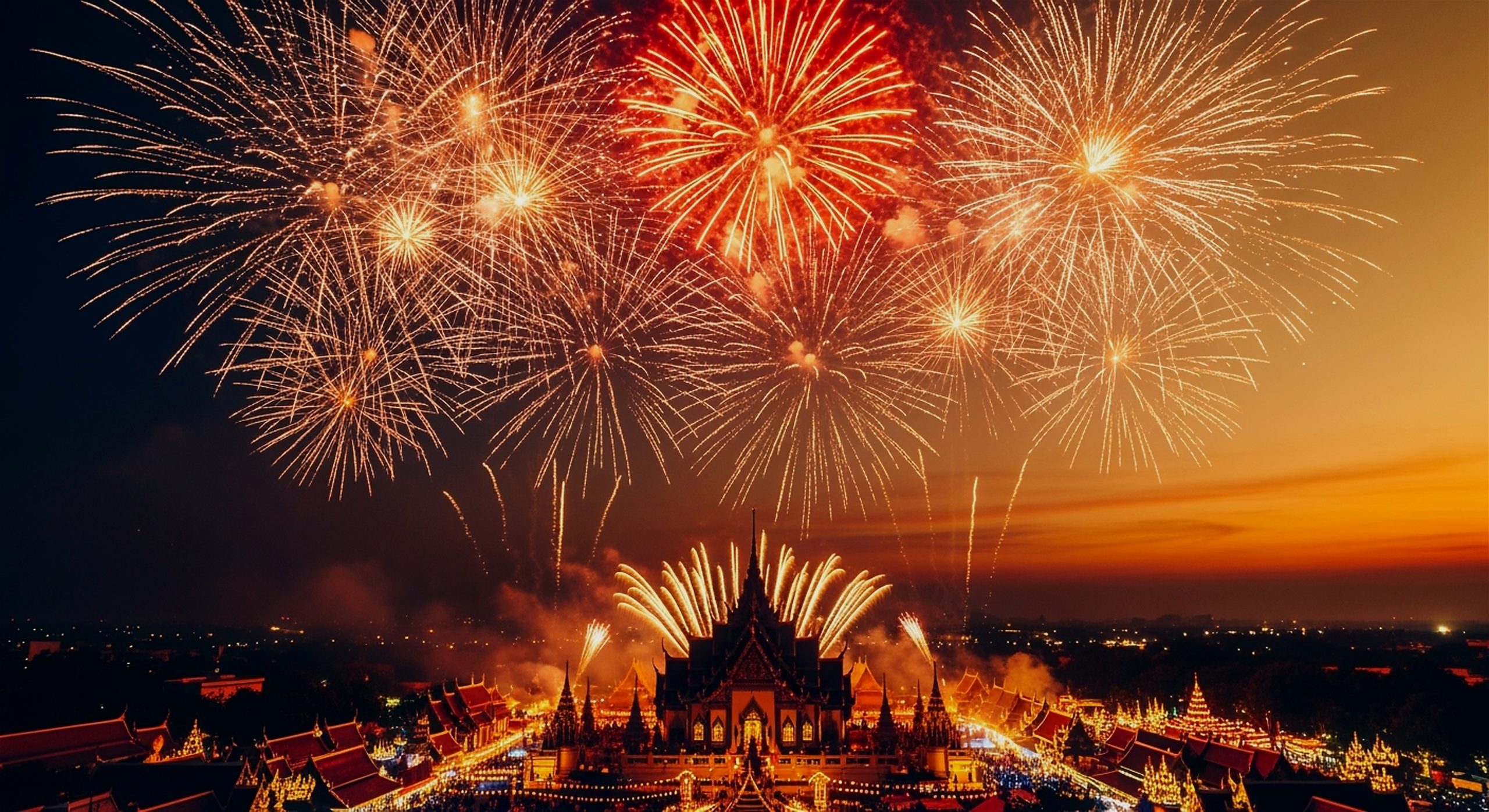
Saturday night, June 27, 2026, was supposed to deliver another installment of one of the more ambitious civic entertainment programs Las Vegas has staged in years: a synchronized fireworks show launching simultaneously from Resorts World Las Vegas, Fontainebleau Las Vegas, and The STRAT Hotel, Casino & Tower, part of an eight-Saturday celebration leading up to America’s 250th anniversary.
Instead, the wind won.
With sustained winds forecast to exceed 30 mph across the valley, organizers made the call to postpone the show entirely, rescheduling it for 9 p.m. Sunday instead. “Launching fireworks in excessive winds could compromise the safety of the crew and spectators,” organizers said in a statement. “While we’re disappointed to postpone tonight’s show, safety remains our top priority. We look forward to celebrating with a spectacular fireworks display tomorrow evening.”
It’s a small story on its surface, a single night’s entertainment shuffled by one day. But it sits at the intersection of several things happening simultaneously in Las Vegas right now: an ambitious year-long civic celebration, a wildfire-driven Red Flag Warning gripping the region, and the practical reality that even the most carefully choreographed entertainment spectacle has to bend to weather it cannot control.
The Program Behind the Postponement
This wasn’t a standalone fireworks show. It’s one installment in an eight-consecutive-Saturday program running from June 6 through July 25, organized as part of Las Vegas’s broader America250 celebration marking the United States’ semiquincentennial.
The full schedule rotates launch locations across the Strip’s most recognizable properties. The series opened on June 6 with fireworks from Caesars Palace, Treasure Island, and The Venetian Resort. June 27, the night that got postponed, was set to feature Resorts World Las Vegas, Fontainebleau Las Vegas, and The STRAT. The program continues July 11 with MGM Grand, Aria Resort & Casino, and Planet Hollywood Resort & Casino, then returns to Resorts World, Fontainebleau, and The STRAT on July 18, before closing the series on July 25 back at Caesars Palace, Treasure Island, and The Venetian Resort.
Each show runs eight minutes, synchronized to a musical broadcast carried across three local radio stations, KOMP 92.3 FM, 97.1 FM The Point, and 98.9 HANK FM, giving anyone watching from across the valley, not just from the Strip itself, the ability to experience the synchronized audio alongside the visual display. The Sphere joins the celebration as well, programming its exterior display to coordinate imagery with each show.
The centerpiece of the entire program arrives July 4 itself, when Las Vegas plans what organizers describe as fireworks on the largest stage in the country: a single synchronized display launched simultaneously from nine rooftops across the Strip. That’s a genuinely massive undertaking, coordinating pyrotechnics, timing, and safety clearances across nine separate properties at once, all timed to detonate in unison rather than as nine independent shows happening near each other.
Why Wind Specifically Is the Dealbreaker
Professional fireworks displays operate under wind restrictions that are far more conservative than most spectators realize. The 30 mph threshold cited for Saturday’s postponement isn’t an arbitrary cutoff. It reflects established pyrotechnic safety standards that govern how high-altitude aerial fireworks behave once they’re aloft.
A fireworks shell launched into 10 or 15 mph winds drifts only modestly from its intended position before detonating, a deviation choreographers can plan around. Push that wind speed past 25 to 30 mph, and the drift becomes unpredictable enough that a shell intended to burst safely over an unpopulated zone, water, parking structure, or buffer area can instead drift toward spectator areas, nearby buildings, or roadways before it ignites.
There’s a second risk that matters even more in a market like Las Vegas: falling debris. Spent shell casings, unexploded duds, and burning fragments all fall back to earth after a fireworks display, and pyrotechnic safety planning accounts for where that debris will land under expected wind conditions. High winds make that calculation unreliable. Debris that should land in a controlled exclusion zone can instead drift over public sidewalks, busy roadways, or crowds gathered to watch from adjacent properties, exactly the kind of dense pedestrian environment that defines the Las Vegas Strip on any given Saturday night.
Given that the show launches simultaneously from three separate properties spread across a stretch of the Strip, with thousands of spectators positioned at viewing points up and down the corridor, the safety margin for error shrinks considerably compared to a single isolated fireworks display in an open field. Postponement, while disappointing to anyone who planned their Saturday night around the show, is the conservative and correct call under those wind conditions.
The Broader Weather Pattern This Fits Into
Saturday’s wind wasn’t an isolated weather event. It arrived as part of the same Red Flag Warning conditions that have repeatedly hit Southern Nevada throughout June, the same pattern responsible for the explosive growth of the Kane Springs and Grapevine wildfires burning in Lincoln County roughly 125 miles northeast of the city.
A Red Flag Warning specifically covering strong winds and increased wildfire risk was in effect across the region heading into that weekend, with forecasters describing a strong area of low pressure moving slowly across the region, bringing both the dangerous wind conditions and, notably, a cooldown in temperatures behind it. That’s the same broader atmospheric pattern, not a coincidental second weather event, driving both the wildfire danger in rural Nevada and the fireworks postponement on the Strip.
It’s a useful illustration of how a single weather system creates cascading effects across very different parts of a region. The same wind that forces a Las Vegas Strip entertainment company to push a show back 24 hours is, at that same moment, actively spreading wildfire perimeter lines that firefighters spent days establishing in the wilderness north of the city. Different consequences, same underlying cause.
What Organizers Got Right
The decision-making process worth highlighting here isn’t really about the postponement itself, it’s about how quickly and decisively organizers acted once the forecast made the safety calculation clear. There’s a version of this story where organizers attempt the show anyway, citing crowd expectations or sunk costs in promotion and staffing, and create a genuinely dangerous situation. That didn’t happen.
The statement from organizers, explicitly naming safety as the deciding factor and committing to a specific, near-term rescheduled date rather than an open-ended postponement, reflects the kind of crisis communication that minimizes both safety risk and reputational damage. Spectators who showed up Saturday night disappointed had a clear, immediate alternative: come back Sunday at the same time.
That immediate rescheduling matters practically too. Pyrotechnic crews, safety personnel, and the synchronized radio broadcast infrastructure were all already staffed and prepared for Saturday night. Shifting the show by a single day, rather than skipping the date in the rotation entirely or pushing it weeks out, meant minimal additional cost and logistics disruption while still delivering the actual show to the public on a date close enough to the original that it didn’t disrupt the broader eight-week program’s momentum.
The Thunderbirds Carried On
Notably, not every planned element of the weekend’s patriotic programming got postponed. The U.S. Air Force Thunderbirds flyover, scheduled to depart Nellis Air Force Base at 7:15 p.m. that same evening as part of the broader America250 celebration, proceeded as planned despite the same wind conditions that grounded the fireworks.
That distinction is worth understanding. Military aircraft, particularly the high-performance jets the Thunderbirds fly, operate under entirely different wind tolerance parameters than ground-launched pyrotechnics. Fighter jets are specifically designed to handle far more extreme wind shear and turbulence than a fireworks shell drifting passively through open air after launch. The flyover’s six-jet delta formation, departing Nellis and flying a planned loop across the Las Vegas Valley before arriving at Las Vegas Ballpark as part of a separate “Battle For Vegas” event, represented an entirely different risk calculation that the same wind conditions didn’t meaningfully affect.
That single weekend, then, offered a small but clear lesson in how different forms of aerial spectacle carry entirely different safety thresholds. What grounded fireworks barely registered as a consideration for military jets covering the same airspace just hours apart.
What This Means for July 4 Planning
With the centerpiece nine-rooftop synchronized show scheduled for July 4 itself, still more than a week away from this particular postponement, organizers have a useful data point heading into the year’s biggest night. June’s Red Flag Warning pattern, recurring multiple times across the month, suggests wind-driven postponement risk is a real and recurring possibility for outdoor events in Las Vegas this summer, not an unusual one-off circumstance.
That doesn’t mean the July 4 show faces any particular elevated risk beyond what any outdoor event in Las Vegas faces during peak fire season. But it does suggest organizers, having now navigated one postponement successfully, have a tested playbook for handling weather disruptions to high-profile, multi-property synchronized pyrotechnic displays should similar conditions arise again on the holiday itself. Quick public communication, a clear and near-term rescheduled date, and continuing with non-pyrotechnic elements of the broader celebration that aren’t subject to the same wind restrictions.
For a city whose identity is built substantially around spectacle, and whose tourism economy depends on delivering that spectacle reliably regardless of circumstances, having a tested, low-friction process for handling exactly this kind of weather disruption is a genuinely useful piece of institutional knowledge heading into the program’s biggest remaining night.
The Bigger Picture
A one-night fireworks postponement isn’t, by itself, a significant story. What makes it worth examining is what it reveals sitting alongside everything else happening in Southern Nevada this same week: wildfires burning uncontained across tens of thousands of acres in Lincoln County, Red Flag Warnings repeating across the region throughout June, and a fourth-warmest June on record building toward what forecasters expect will be the hottest stretch of the year so far.
Las Vegas runs on outdoor spectacle. Fireworks, the Sphere’s exterior displays, outdoor concerts, the Strip’s entire open-air entertainment ecosystem. All of it depends on weather cooperating, at least within reasonable bounds. What this particular weekend demonstrated is that even a city built around delivering reliable spectacle regardless of circumstance still has to bend, occasionally, to conditions it simply cannot control.
The show goes on Sunday instead. The wildfires keep burning regardless of which night the fireworks launch. Both are happening under the same sky, driven by the same weather system, in the same week.
Key Insights
The postponement decision reflects established pyrotechnic safety thresholds around wind speed, where unpredictable shell drift and falling debris become genuine safety hazards above roughly 30 mph, particularly significant given the show’s three-property simultaneous launch format in a dense pedestrian environment.
The same Red Flag Warning weather system responsible for the fireworks postponement was simultaneously driving active wildfire spread in the Kane Springs and Grapevine fires roughly 125 miles northeast, illustrating how single weather events create distinct cascading consequences across very different contexts within the same region.
Organizers’ rapid decision-making and immediate rescheduling to the very next evening, rather than an open-ended postponement, demonstrates effective crisis communication that preserved both public safety and the broader eight-week program’s momentum.
The Thunderbirds flyover proceeding as scheduled despite the same wind conditions that grounded fireworks highlights how dramatically safety tolerances differ between distinct forms of aerial spectacle, offering a useful comparison for understanding weather-related event planning more broadly.
Sources
News3 Las Vegas Fireworks Postponement
8 News Now America250 Coverage
FOX5 Vegas Postponement Report