



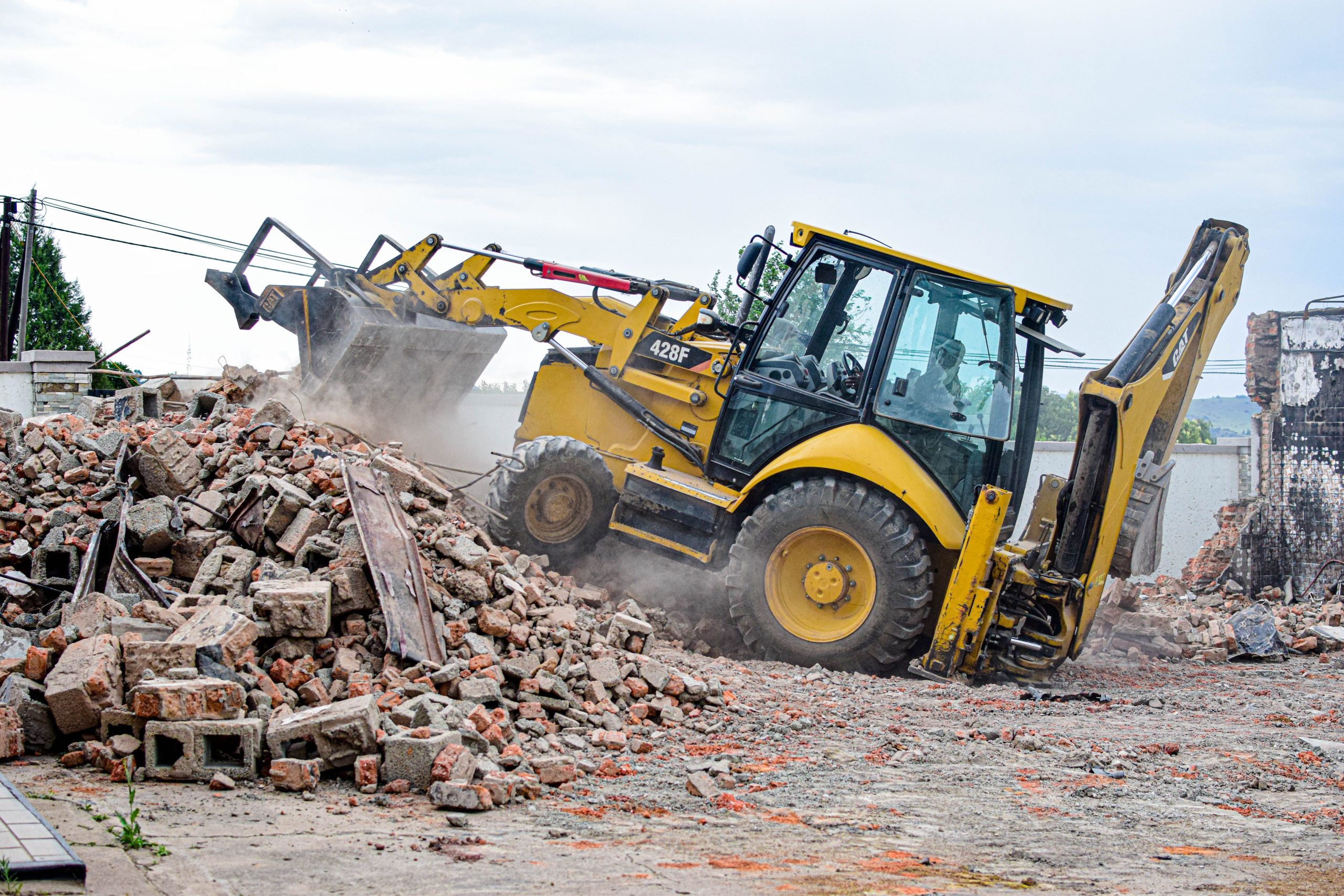
The Royal Resort on Convention Center Drive no longer exists. On Tuesday, September 16, 2026, what had been a two-story independent hotel property near the Las Vegas Strip was turned into a mountain of rubble. The demolition itself was unremarkable in execution: a piece of heavy equipment, a cloud of dust, and a modest structure reduced to debris in the time it takes to hold a city council meeting.
What makes the Royal Resort’s demolition worth examining isn’t the building that came down. It’s what the building’s removal signals about the geography of development pressure adjacent to the Strip corridor and the forces reshaping Las Vegas’s physical landscape in ways that rarely generate the headlines reserved for casino openings and sports announcements.
Convention Center Drive is not the Strip. It sits one block east of Las Vegas Boulevard, running parallel to the most valuable commercial real estate corridor in Nevada. Properties along Convention Center Drive have historically served as overflow infrastructure for the Strip economy, offering lower-cost hotel rooms for budget travelers, meeting facilities for smaller conventions, and the kinds of businesses that support the Strip’s operations without being on it.
That geographic positioning is changing.
The Loop Connection
The Royal Resort’s demolition site sits in the immediate vicinity of the Vegas Loop’s existing infrastructure. The system’s convention center campus stations are the anchor of the current operational network, and the expansion under Paradise Road that is weeks from opening runs through this same corridor.
When transit connectivity improves in a specific area, adjacent land values respond. This is one of the most reliably documented patterns in urban real estate: properties within walking distance of transit stations, particularly those that are the first stops in newly accessible areas, capture a premium that reflects both their improved connectivity and the development pressure that improved connectivity attracts.
Convention Center Drive is not currently within walking distance of a Loop station in the same way that Resorts World or Fontainebleau are directly connected. But the Loop’s planned expansion to 28 stations by year-end, and its longer-term ambition of 123 stations across 68 miles of tunnel, positions the convention corridor as increasingly integrated into the system’s operational geography. Properties in that corridor that are currently underutilized relative to their land value face the same incentives that have driven demolition and redevelopment throughout Las Vegas’s history: at some point, the building is worth less than the dirt underneath it.
The Royal Resort apparently crossed that threshold. Its owner’s decision to demolish rather than renovate or hold reflects a calculation that the land has more value without the existing structure than with it, whether because a different building can be built on the site or because the cleared land will be sold to a developer for a use the current property couldn’t support.
The Strip’s Development Patterns
Las Vegas’s built environment has always been characterized by cycles of construction, operation, and demolition that shorter-memory observers mistake for permanence. The Sands, the Dunes, the Stardust, the Riviera, the Landmark Hotel: properties that once defined Las Vegas’s identity were torn down when their economic productive life ended and the land was worth more for a different purpose.
The pattern accelerated in the 2000s as Strip land values reached levels that made anything less than maximum-density, maximum-revenue-generating use economically irrational. The Mirage itself, which closed in July 2024 and is now becoming the Hard Rock Las Vegas Guitar Hotel, is the most recent major example of a property that had reached the end of one economic life cycle and was converted for another.
Properties adjacent to the Strip face similar logic on a compressed scale. Convention Center Drive and the surrounding blocks don’t carry Strip-level land values, but they carry values that have risen substantially as the surrounding area has developed. A two-story independent hotel with relatively low revenue-per-square-foot economics becomes increasingly mismatched with its land value as the neighborhood around it intensifies.
The Royal Resort’s demolition is one data point in that pattern. It happens to arrive at a moment when other indicators of development pressure in the same corridor are visible: the Vegas Loop’s expansion into Paradise Road, the ongoing construction of the Hard Rock Guitar Tower one block over on Las Vegas Boulevard, and the broader investment activity in the convention campus area that makes this particular geography more valuable than it was even five years ago.
What Replaces It Matters
Demolitions are only one chapter in a real estate story. The chapter that matters is what comes next.
As of Tuesday, the former Royal Resort site is a cleared lot. No announcement of what will replace it accompanied the demolition. That absence of announced plans could mean several things: the site was cleared to prepare for a buyer who hasn’t been publicly revealed, the owner is holding cleared land as an investment while market conditions develop, or development plans exist but haven’t been through the public approvals process yet.
Las Vegas’s development pipeline in the Convention Center Drive corridor includes a mix of possibilities. Hotel development that replaces older, lower-margin properties with newer, higher-rate product serving the convention business continues to find demand. Mixed-use development that combines hotel rooms, retail, and meeting space serves the same convention customer in formats that generate more revenue per square foot than a simple hotel. Office and commercial development serving businesses that support the Strip economy occupies another slice of the market.
Whatever comes to the Royal Resort site will be shaped by the same factors shaping development decisions throughout the corridor: proximity to the convention campus, relationship to the emerging Loop network, and the demand from both convention business and leisure travelers for accommodations that are close to the Strip without being on it.
The Demolition Tax
Las Vegas residents who live and work outside the tourism corridor rarely notice individual demolition events. The Royal Resort’s disappearance will register for the people who drove past it, the former guests who stayed there, and the employees whose jobs at the property ended when the building did. For everyone else, a two-story independent hotel turning into a rubble pile is background noise in a city where construction and demolition are essentially continuous.
What does accumulate in residents’ consciousness over time is the aggregate effect of these individual transitions: neighborhoods that shift from one character to another as properties cycle, traffic patterns that change as development intensifies certain corridors, and the gradual transformation of Las Vegas from a city that grew around tourism into a city whose residential neighborhoods exist in complicated relationship with the tourism economy that shaped them.
The Convention Center Drive corridor’s evolution over the next decade will be shaped partly by large announced projects like the Hard Rock renovation and the Loop expansion, and partly by dozens of smaller property decisions like the Royal Resort demolition that rarely generate their own headlines. Together, those decisions compose the texture of what this part of Las Vegas becomes.
The building is gone. The land is cleared. Las Vegas’s next chapter for that particular piece of real estate is being written right now, without an audience and without a press release.
Key Insights
The Royal Resort demolition reflects the economic calculus that drives Las Vegas’s continuous redevelopment cycle: when a property’s revenue-generating capacity falls sufficiently below its underlying land value, demolition and redevelopment becomes economically rational regardless of the building’s functional condition.
Convention Center Drive’s position one block from Las Vegas Boulevard, combined with the Vegas Loop’s expanding tunnel network through the adjacent Paradise Road corridor, creates compounding transit connectivity improvements that increase land values and development pressure throughout the area in ways that accelerate the obsolescence of lower-density existing uses.
The absence of announced replacement plans for the Royal Resort site reflects the normal pattern of Las Vegas property development, where demolition often precedes public development announcement rather than following it, leaving cleared land as a signal of changed economics rather than a statement of specific intentions.
Las Vegas’s built environment instability, with its continuous cycle of construction, operation, and demolition across every segment from Strip megaresorts to adjacent corridor properties, reflects the specific economics of tourism-driven real estate where land value appreciation consistently outpaces the productive life of buildings designed for a specific market moment.
Sources
Las Vegas Review-Journal Royal Resort Demolition
Las Vegas Review-Journal Convention Center Drive Coverage
FOX5 Vegas Demolition Report
Las Vegas Review-Journal Vegas Loop Expansion
Las Vegas Review-Journal Development Pipeline