


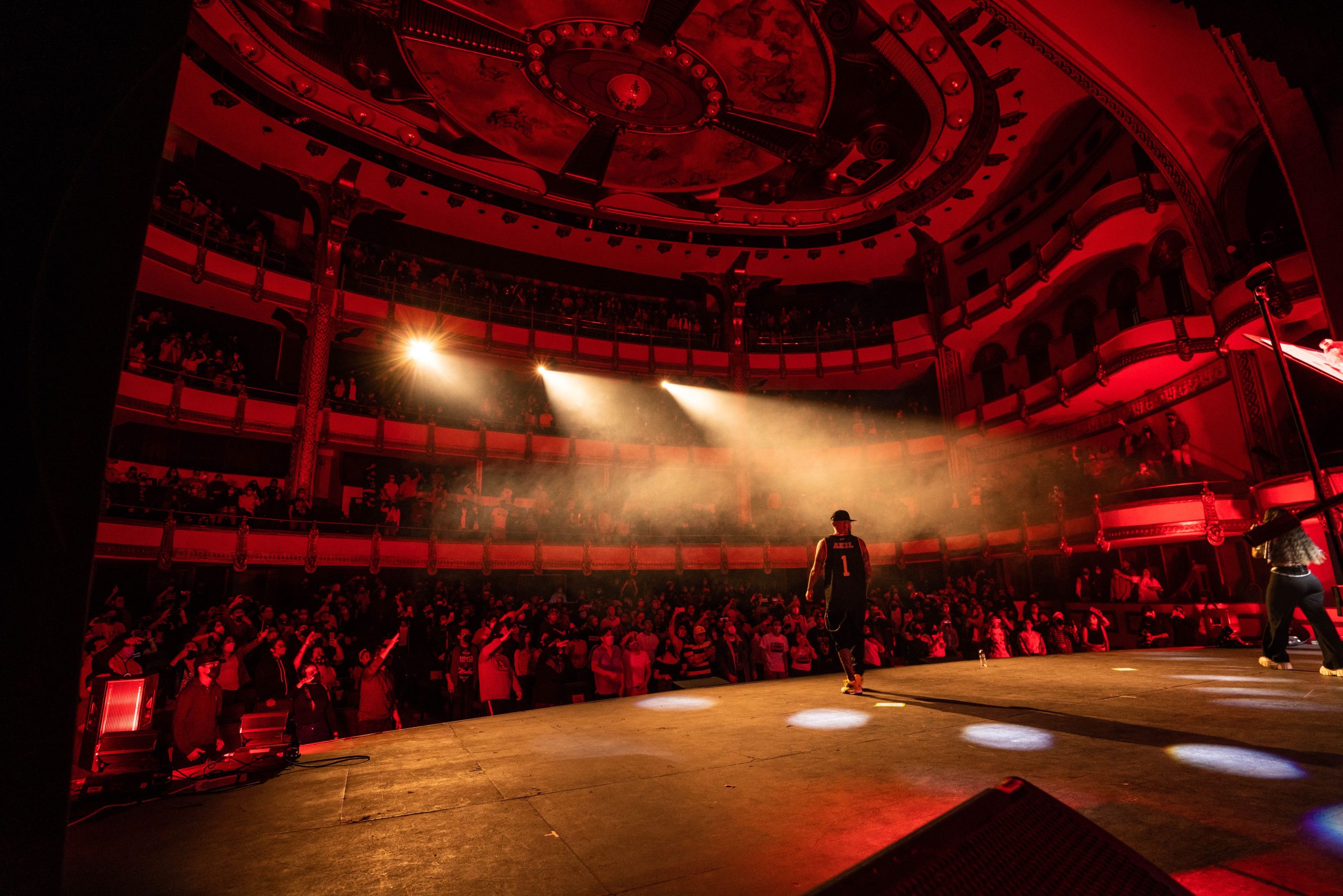
Friday night, July 10, 2026. Allegiant Stadium, Las Vegas. The concourse fills with buchonas in fitted leather and muchachos in pristine tejanas. Silver belt buckles catch the light. Black denim moves through the corridors in what the Las Vegas Weekly reviewer described as a procession with its own unspoken uniform. By showtime, all 65,000 seats are full.
The show runs more than three hours. Jesús Ortiz Paz, the frontman known universally as JOP, burns through over 40 songs while a 12-piece ensemble transforms stadium-scale sound with acoustic 12-string guitars, tuba, and upright bass. The Jabbawockeez appear for an unbilled onstage cameo. Marshmello joins via video for their collaborative hit Harley Quinn. JOP sits in a recreation of his childhood bedroom during one segment. A fashion-show catwalk appears during another. The production pivots between corrido-and-horn arrangements and modern trap influences without losing the thread.
The San Bernardino-born band may be playing some of the biggest venues in North America, but it still carries Inland Empire DNA everywhere it goes.
That Inland Empire DNA, the aesthetic of a group that formed in San Bernardino drawing from roots in Jerez, Zacatecas, Mexico, filling Allegiant Stadium to capacity is the most significant development in the Las Vegas concert market in 2026 that has received the least analysis in mainstream entertainment media. Fuerza Regida’s This Is Our Dream tour is not a curiosity or a demographic story. It is a stadium-scale commercial achievement that demands business examination.
The Trajectory That Made July 10 Inevitable
Fuerza Regida sold out both the Hollywood Bowl and Madison Square Garden in the same weekend, a feat described as unprecedented, en route to their first nine-stop stadium tour. This happened before the Las Vegas date. By the time Allegiant was added to the sellout list, it was the fourth tour stop and the band was already operating with the kind of touring momentum that changes how venues and promoters evaluate future bookings.
The band’s streaming position is the underlying foundation. The group transformed from a local San Bernardino act into one of Spotify’s top eight most-streamed artists globally. That ranking is not genre-specific. It is absolute, measured against every artist in every genre on the platform. A group that began playing Inland Empire parties is now among the eight most-streamed artists on the world’s largest music platform, competing for streaming share with the biggest names in pop, hip-hop, and Latin music internationally.
This streaming foundation drives concert demand in ways that traditional radio-based popularity measurements do not capture. Listeners who stream billions of combined plays are motivated by genuine catalog engagement rather than radio familiarity. They know the songs, they know the words, and they travel to see live performance with the kind of investment that casual radio familiarity does not generate.
The corridos tumbados format itself deserves analysis as a commercial product rather than simply as a cultural artifact. Fuerza Regida has refused to treat música mexicana like a museum piece. The genre blends traditional regional Mexican instrumentation, tubas, accordion, 12-string acoustic guitars, with modern trap production elements: aggressive sub-bass, contemporary mixing aesthetics, and lyrical themes that address contemporary street reality alongside traditional corrido subjects. This is not a preservation project. It is a living genre that speaks to present experience using instruments and song structures rooted in Mexican musical tradition.
What Selling Out Allegiant Stadium Means for the Genre
Prior to this touring cycle, música mexicana’s commercial ceiling in American stadium venues was the subject of legitimate uncertainty. The genre had produced sold-out shows at mid-size venues and some arena-level results in markets with dense Mexican-American populations. The Hollywood Bowl and Madison Square Garden sellouts were significant but could be attributed to specific demographic concentrations in Los Angeles and New York respectively.
Las Vegas changes that analysis. The Las Vegas market’s demographic composition is genuine but does not have the same Mexican-American population density as Los Angeles. The stadium sellout in Las Vegas demonstrates that demand for Fuerza Regida’s corridos tumbados extends beyond geographically concentrated communities to a broader tourism-adjacent audience that travels specifically for the concert experience.
The tuba hit harder. The guitars bit deeper. Every bass note landed with enough force to keep the thousands on their feet and continuously sidestep at their seats. Las Vegas Weekly’s review documented not just attendance but genuine crowd engagement sustained across three-plus hours, which is the definitive test of whether a stadium show delivered on its promise.
The nine-city stadium tour as a complete unit established infrastructure that corridos tumbados did not previously have at this scale. Petco Park in San Diego. Oracle Park in San Francisco. T-Mobile Park in Seattle. Allegiant Stadium in Las Vegas. Chase Field in Phoenix. Dodger Stadium in Los Angeles. Daikin Park in Houston. Globe Life Field in Arlington. Citi Field in Queens. These are not all markets with dominant Mexican-American populations. They are major American cities where música mexicana demonstrated sufficient demand to fill professional sports stadiums. That geographic breadth is the commercial validation that turns a breakthrough into a category shift.
The Production at Stadium Scale
The choice to perform with a 12-piece ensemble at stadium scale rather than the DJ-and-backing-track format that most touring acts at this level use reflects artistic commitment that has real production cost implications.
Touring with a 12-piece ensemble means 12 additional musicians’ fees, travel costs, accommodation costs, and the additional stage infrastructure and sound engineering required to balance acoustic instruments against electronic production at the volume levels that 65,000-seat venues demand. This is a meaningful incremental budget allocation relative to a DJ-and-tracks setup.
The acoustic 12-string guitars, tuba, and upright bass that the Las Vegas Weekly review specifically highlighted are not decorative additions. They are the textural core of the corrido sound that distinguishes the genre from the electronic productions it has absorbed influence from. Maintaining those acoustic elements at Allegiant Stadium scale requires audio engineering discipline that electronic-only productions do not need to practice.
The visual production, including the childhood bedroom recreation, fashion-show catwalk, Jabbawockeez appearance, and Marshmello video integration, demonstrates understanding that a three-hour stadium show serving a diverse audience requires structural variety that maintains energy without relying on continuous intensity. The production pivots between intimate storytelling moments and full-ensemble power in ways that mirror the emotional range of a setlist spanning 40-plus songs from a catalog that covers multiple stylistic periods.
Allegiant Stadium as the Right Room
We have examined Allegiant Stadium’s transition into a premier stadium touring stop throughout this series, noting its role hosting AC/DC on August 1 and Guns N’ Roses on August 22. Fuerza Regida’s July 10 date adds a third major 2026 stadium show and a third distinct audience demographic.
The demographic at Allegiant for Fuerza Regida is measurably different from both the AC/DC and Guns N’ Roses audiences. Age distribution skews younger. Geographic origin within the Las Vegas metro area is more local-heavy relative to the pure tourist composition of classic rock shows. Cultural reference points and social practices around concert attendance differ in ways that affect everything from concession preferences to crowd behavior patterns to the afterparty economy the show generates.
This demographic diversity across three 2026 Allegiant shows illustrates the point this series has returned to repeatedly: Las Vegas’s entertainment economy sustains simultaneous growth across categories precisely because the audiences are distinct rather than competing. The person who attended Fuerza Regida on July 10 was not the person who would have attended AC/DC on August 1. The city’s infrastructure absorbed all of them.
The Broader Latin Music Inflection at Allegiant
Fuerza Regida’s Allegiant sellout occurred in a Las Vegas market that the Las Vegas Sun described as seeing Latin programming gain significant commercial traction across multiple venue formats. The weekly Azúcar Latin party at Sugar Factory on the Strip, described in Las Vegas Weekly’s event listings as Las Vegas finally has its Latin party, operates at the neighborhood scale. The Fuerza Regida stadium sellout operates at the other end of the spectrum.
The distance between Azúcar at Sugar Factory and Fuerza Regida at Allegiant Stadium is the distance between an emerging cultural moment and a fully realized commercial category. Latin music in Las Vegas has covered that distance. The question for venue operators and promoters is whether they build programming infrastructure that captures the full spectrum from neighborhood Latin nights through arena residencies and stadium shows, or whether they leave parts of that spectrum underserved.
The answer that the July 10 sellout suggests is that underserving the Latin music market at any tier carries increasing commercial risk as the demographic and commercial momentum of música mexicana specifically continues developing.
Key Insights
Spotify top-eight global streaming position provides concert demand foundation that transcends demographic concentration, enabling sellout performances in markets without dominant Mexican-American populations and demonstrating geographic breadth beyond community-specific touring. Simultaneous Hollywood Bowl and Madison Square Garden sellouts established cross-coastal stadium credibility before the nine-city tour that converted regional breakthrough into documented national infrastructure.
Twelve-piece acoustic ensemble touring commitment incurs meaningful incremental cost relative to electronic-only production while preserving the textural authenticity that distinguishes corridos tumbados from the electronic influences it has absorbed. Three-hour-plus setlist diversity spanning 40-plus songs with varied production segments, from childhood bedroom storytelling to full-ensemble power moments, maintains crowd engagement across extended duration without relying on continuous intensity that most stadium acts cannot sustain. July 10 Allegiant sellout as fourth tour stop demonstrates demand persistence beyond opening-market novelty and validates genre’s stadium-scale commercial viability in tourist-heavy markets without demographic concentration advantages.
Notes on What Stadium Music Looks Like Going Forward
The Fuerza Regida This Is Our Dream tour is part of a broader reorganization of what American stadium music encompasses. Ten years ago, a Latino group drawing from Mexican regional music traditions performing a nine-city American stadium tour would have been described as unprecedented in most music industry conversations.
Today it is documented commercial reality, with receipts. The sellouts happened. The reviews confirm the crowd engagement was genuine. The 12-piece ensemble played to 65,000 people in Las Vegas on a Friday night in July.
The music industry’s understanding of which artists can fill stadiums has always lagged behind actual audience behavior. The audience for corridos tumbados demonstrated long before the industry’s major touring infrastructure took it seriously that the market was there. The This Is Our Dream tour is the moment when the infrastructure caught up.
Las Vegas provided a specific and important data point in that catching-up: a stadium sellout in a tourist-heavy market rather than a demographically concentrated community proves that the music travels beyond its origin culture to audiences who encounter it through streaming platforms, social media, and the kind of organic discovery that genre-transcendent commercial quality produces. Fuerza Regida filled Allegiant Stadium the way any stadium act fills a stadium: because the music is good enough to make 65,000 people want to be in the same room to hear it together.
That is what stadium music is, regardless of what language it is sung in or what instruments play beneath it.