



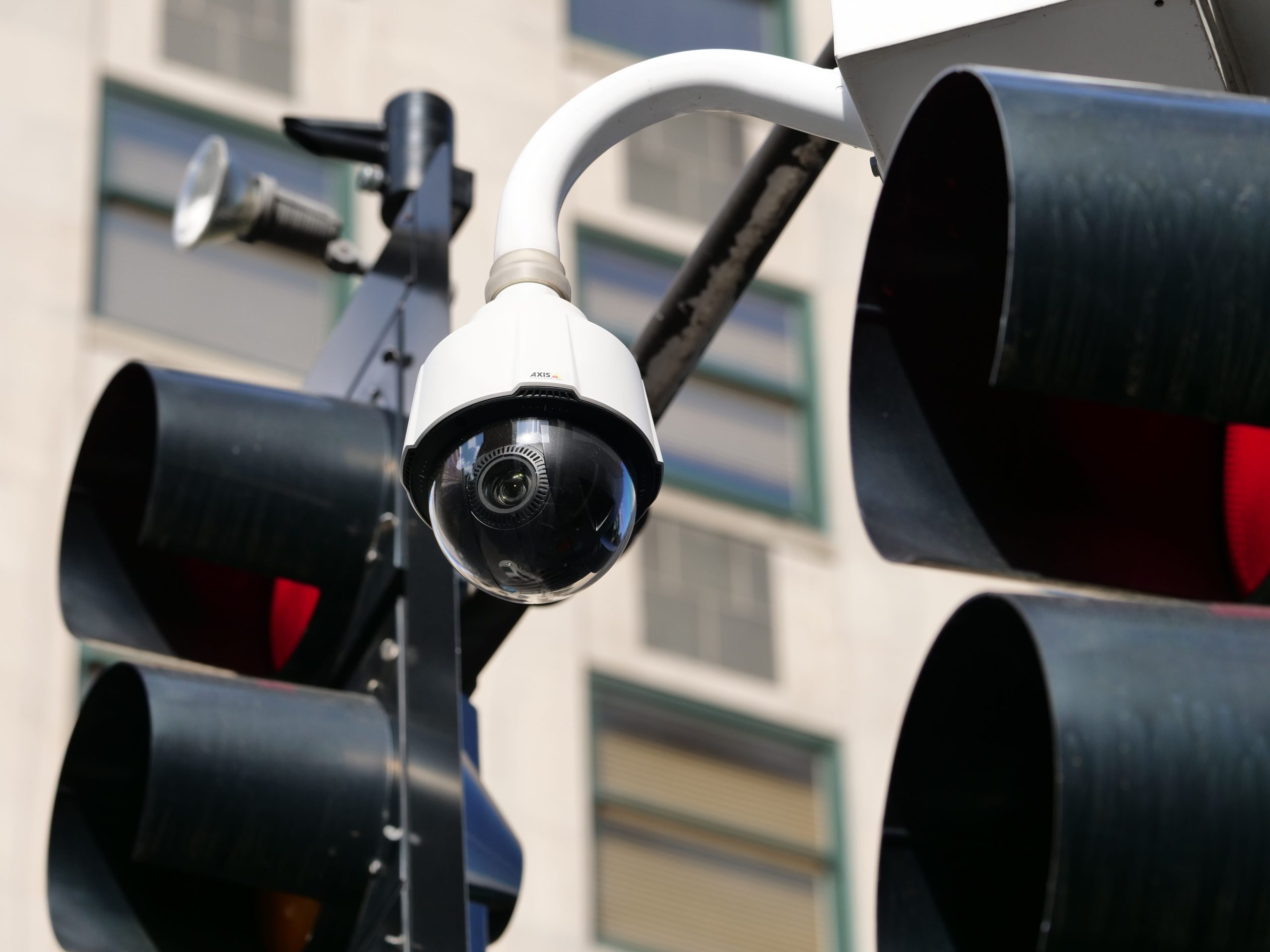
A Crosswalk That Follows You
One block from the Fremont Street Experience, at the intersection of First Street and Ogden Avenue, something unusual has been happening since August 12, 2026. When a pedestrian approaches the crosswalk, a camera mounted overhead detects the approaching figure. A dynamic LED lighting array activates and tracks the person across the street, keeping them illuminated from above as they walk, making them visible to drivers in ways that standard overhead streetlights never achieve. When no one is crossing, the system maintains a static light on the crosswalk, conditioning drivers to the crossing’s presence before the active tracking mode engages.
This is the SecurOS Soffit, an AI-powered crosswalk illumination system developed by New Jersey-based Intelligent Security Systems, installed at that downtown intersection on August 12 as part of Las Vegas’s Vision Zero initiative. It doesn’t record or store video. It detects, tracks, and illuminates. The distinction matters enormously in a city where privacy concerns about surveillance technology are real, and where the tourism population moving through Fremont Street’s corridors didn’t sign up to be filmed.
Simultaneously, the city is installing 16 AI-powered smart traffic signals along the five-block Fremont Street Experience corridor, funded by a $1.4 million federal grant secured by Congresswoman Dina Titus. These signals read pedestrian body language and gaze to determine when someone intends to cross, automatically adjusting signal timing without requiring anyone to push a button. The pedestrian who steps toward the curb and looks up at the light triggers a response from the system before they’ve done anything manually.
Taken together, these two deployments represent the most concentrated application of artificial intelligence to pedestrian infrastructure in Las Vegas’s history, arriving at a moment when the city is simultaneously deploying autonomous vehicles on the Strip and expanding smart highway technology on I-11. Las Vegas is building an AI transportation layer across its physical infrastructure, one intersection at a time.
Why Downtown Las Vegas Needs This
The statistics that motivated these investments are not abstract. Between 2019 and 2023, Las Vegas recorded 1,131 traffic-related fatalities. More than half involved vulnerable road users, including motorcyclists, bicyclists, and pedestrians. In a city whose entire economic model depends on moving millions of people through dense, distracted, alcohol-adjacent urban environments at all hours, pedestrian safety has been a chronic and deadly failure.
The Fremont Street Experience specifically presents conditions that test the limits of standard traffic engineering. More than 24 million visitors travel through the corridor annually, creating pedestrian volumes at intersecting streets that few uncontrolled crossings in the country see. Tourists in vacation mode don’t always look before crossing. They don’t always find the push button. They assume traffic will stop for them in ways that don’t account for how Las Vegas drivers navigate the corridor. And they cross in groups whose size and speed vary wildly compared to the fixed timing assumptions built into traditional signal systems.
Erin Breen, director of PED Safe Vegas at UNLV, explained the push-button problem directly: “In an area like Fremont Street where there’s a ton of foot traffic, everybody thinks that the other guy pushed the button. And so what happens is no one pushes the button.” A signal that requires a button press to extend crossing time fails specifically in dense tourist environments where diffused responsibility means the button often doesn’t get pushed even when dozens of people are waiting to cross.
The AI solution eliminates this failure mode. The system detects how many people are waiting, reads their directional intent from body language and gaze, and extends crossing time proportionally. More people waiting, more time provided. Faster pedestrians, less time needed. The signal responds to what’s actually happening rather than executing a fixed program that was calibrated for a population that doesn’t quite match the Fremont Street reality.
The SecurOS Soffit: What It Does and Doesn’t Do
The distinction between what the Soffit does and what conventional surveillance technology does deserves careful attention because public acceptance of AI safety infrastructure depends on understanding the difference.
Conventional streetlights broadly illuminate a surrounding area. They’re designed for general visibility across a zone, which means vehicles can see the illuminated area but individual pedestrians may still be difficult to spot against the visual noise of a dense urban environment. The Soffit doesn’t illuminate the area. It uses analytics to detect pedestrians as they approach and traverse the crosswalk, directing a dynamic LED lighting array to escort each person across the street, tracking their movement to make them more visible to approaching vehicles. This targeted illumination increases driver awareness without creating glare or unnecessary light pollution.
The tracking behavior is what makes the system effective and also what generates privacy concern. A system that follows individual pedestrians with a directed light beam is, by definition, a system that can identify and track specific individuals in a public space. The distinction the city has drawn, that the Soffit detects and illuminates without recording or storing video, addresses the surveillance concern by separating the tracking function from the data retention function. You can be tracked while you cross without your crossing being added to any database.
Whether that distinction holds up in practice, and whether the public trusts it to hold up, will determine how the technology scales beyond this initial installation. Las Vegas Mayor Shelley Berkley’s comment about the broader smart signal rollout captures the pragmatic approach: “If it works, we’ll implement it citywide. If it doesn’t work, then we go back to hitting the button. Sometimes the old ways work better, but we’ll see what happens.”
The I-11 SafeTech Corridor
The downtown AI pedestrian infrastructure exists alongside a larger smart transportation investment that launched in May 2026 on one of Las Vegas’s busiest freeway corridors. The Nevada Department of Transportation, in partnership with the Regional Transportation Commission of Southern Nevada, began construction on the I-11 SafeTech Corridor Project on May 31, 2026, along approximately five miles of Interstate 11 between Summerlin Parkway and the Spaghetti Bowl interchange.
The approximately $22 million project, funded through a combination of federal, state, regional, and local transportation sources, is designed to improve real-time traffic operations, congestion management, and roadway safety. Major improvements include seven Active Traffic Management gantries capable of displaying real-time speed advisories, lane-use information, and incident messages above the freeway. Twelve Wrong-Way Driver Alert Systems at six interchange locations will detect vehicles traveling in the wrong direction and alert both drivers and transportation officials.
Wrong-way driving on Las Vegas freeways is a specific and recurring safety problem that has generated significant attention. Impaired drivers, confused tourists, and distracted commuters all contribute to wrong-way incidents that are disproportionately deadly because they produce head-on collisions at highway speeds. The 12 wrong-way detection systems across the I-11 corridor represent a direct technological response to a well-documented local hazard.
The expansion of the SafeTech Corridor concept to I-11 follows earlier deployments elsewhere in Nevada, with FOX5 reporting this week that NDOT’s high-tech “Safe Tech Corridor” is now expanding specifically to Las Vegas’s I-11, bringing wrong-way driver detection and variable speed limits to one of southern Nevada’s busiest freeway corridors.
Vision Zero and the 2050 Target
Both the pedestrian AI investments and the I-11 SafeTech Corridor fit within Las Vegas’s Vision Zero initiative, the data-driven policy framework aimed at eliminating traffic-related fatalities and severe injuries by 2050. Vision Zero, originally launched in Europe in the late 1990s, has been adopted by more than 70 American communities, all pursuing the principle that traffic deaths are not inevitable and that engineered solutions can drive them toward zero.
Las Vegas’s adoption of Vision Zero is particularly meaningful given the city’s specific pedestrian safety challenge. The combination of alcohol, unfamiliar environments, high pedestrian volumes, and a tourism culture that encourages risk-taking creates a context where standard traffic engineering produces worse outcomes than comparable environments without those compounding factors. AI-powered systems that respond dynamically to actual conditions rather than fixed assumptions are better suited to this environment than the push-button signals and fixed-timing lights they replace.
The 2050 target gives the initiative a generational horizon that allows for experimentation and iteration rather than demanding immediate perfection. The Fremont Street pilot program is designed to run for approximately two years before evaluation, which means the first meaningful data on whether the smart signals actually reduce pedestrian incidents won’t arrive until 2028. If the data supports expansion, the citywide implementation Mayor Berkley mentioned becomes feasible. If it doesn’t, the city has spent $1.4 million on a learning experience rather than a failed infrastructure bet.
The Tourist and the Algorithm
Las Vegas’s pedestrian AI deployment serves a population that differs fundamentally from the urban residents who use these systems in other deployment contexts. The Vision Zero literature documents success in cities like Oslo and Helsinki, where a stable resident population develops habitual knowledge of how the smart intersection systems work. Fremont Street’s 24 million annual visitors are largely encountering Las Vegas’s infrastructure for the first time, arriving with habits formed in different cities, under different cultural norms, with varying levels of impairment.
The advantage the AI system has over the push-button signal is precisely that it doesn’t require visitors to know how it works. The pedestrian who approaches the Soffit-equipped crossing at First and Ogden doesn’t need to understand that a camera is tracking them and directing light onto their path. They just notice that they can see the light better, and that drivers seem to be stopping more reliably. The system works without requiring behavioral change from the people it’s protecting.
The smart traffic signals similarly don’t require visitors to know that their body language and gaze are being read by cameras connected to signal controllers. They approach the intersection, the light responds, they cross. The underlying AI is invisible to the experience, which is exactly the right design philosophy for a tourist corridor where explaining how the technology works is not a practical option.
The Privacy Debate
Pedestrians’ reactions to the new AI crosswalk technology have been mixed. DJ Plender, a Las Vegas resident, expressed full support: “It would be way more beneficial than looking at it like a counter or a time.” He noted that many lives could be saved: “A lot of lives have been lost historically due to human error. So maybe having that as a safety net could be extremely beneficial.”
The mixed reaction reflects a genuine tension in public AI deployment between safety benefits and surveillance concerns that cities across the country are navigating without clear consensus. Las Vegas’s decision to deploy these systems in one of its highest-visibility tourist corridors puts the conversation in a particularly public setting where the outcome will influence similar decisions in other cities.
The architectural distinction between systems that track without recording, as the Soffit is designed to do, and systems that build databases of individual movement patterns, represents the line that public acceptance tends to fall on. If the city can demonstrate that the Fremont Street deployment genuinely operates on the detection-and-lighting side of that line rather than the surveillance side, the expansion potential is substantial. If incidents occur where the data boundary is crossed or appears to be crossed, the backlash could set back AI pedestrian safety deployment more broadly.
Notes for Stakeholders
Las Vegas’s AI pedestrian infrastructure investments offer insights for anyone working in urban planning, transportation technology, or smart city development:
Tourist-density pedestrian environments require AI solutions that work without user knowledge or behavioral change. Systems that depend on visitors understanding how to interact with them fail in high-turnover tourist corridors where behavioral training isn’t possible.
The distinction between detection and surveillance determines public acceptance of AI infrastructure. Systems that track without storing data occupy a fundamentally different public trust position than those that create permanent records of individual movement.
Pilot programs with defined evaluation timelines create accountability that indefinite deployments lack. The two-year Fremont Street pilot generates decision-relevant data on a specific timeline rather than allowing the technology to persist on inertia.
Vision Zero’s generational timeline enables experimental iteration that short-term safety programs don’t permit. A 2050 target allows cities to deploy, evaluate, and adjust AI safety infrastructure without demanding immediate perfection from first-generation systems.
Wrong-way driver detection on Las Vegas freeways addresses a specific, documented local hazard that standard freeway design doesn’t adequately prevent. Targeted technology responses to well-documented specific problems generate better return on investment than general infrastructure upgrades.
The Light That Follows You Home
There’s something genuinely unusual about walking across a crosswalk in downtown Las Vegas right now. A light overhead tracks your movement, following you across the pavement without your asking it to, without your knowing it’s doing it unless you’ve read about it in the news. The AI watching your gaze and body language to decide when to change a traffic signal operates entirely below the threshold of conscious experience for most people using the intersection.
This invisibility is the design goal and the privacy concern simultaneously. Effective urban AI infrastructure should be transparent to users in the sense that it just works, and transparent to the public in the sense that its operation can be examined and understood by anyone who wants to look. Las Vegas is building the first kind while working to demonstrate the second kind.
Whether the city succeeds at both, and whether the traffic fatality data ultimately validates the investment, will answer questions that dozens of other cities are watching closely from a distance.
Key Takeaways:
- Las Vegas deployed the SecurOS Soffit AI pedestrian safety system at First Street and Ogden Avenue on August 12, 2026, one block from the Fremont Street Experience, which draws over 24 million annual visitors
- The Soffit uses video analytics to detect pedestrians and direct a dynamic LED array to escort each person across the crosswalk, tracking their movement without recording or storing video
- The city is simultaneously installing 16 AI-powered smart traffic signals along Fremont Street, funded by a $1.4 million federal grant secured by Congresswoman Dina Titus, that read pedestrian body language and gaze to automatically adjust signal timing
- Between 2019 and 2023, Las Vegas recorded 1,131 traffic fatalities with more than half involving vulnerable road users including pedestrians, motivating the Vision Zero initiative targeting zero traffic deaths by 2050
- The smart signal pilot will run approximately two years before evaluation, with Mayor Berkley indicating citywide expansion if results support it
- NDOT’s $22 million I-11 SafeTech Corridor expansion launched May 31, 2026, adding seven Active Traffic Management gantries and 12 Wrong-Way Driver Alert Systems across five miles of freeway between Summerlin Parkway and the Spaghetti Bowl
- The tourist environment of Fremont Street makes AI systems that work without user knowledge or behavioral change particularly valuable compared to push-button signals that require visitors to know to use them
- Pedestrian reactions to the AI crosswalk technology are mixed, with supporters citing life-saving potential and critics raising surveillance concerns
- The distinction between detection-without-recording and surveillance-with-data-storage represents the line that determines public trust in AI safety infrastructure
- Las Vegas’s AI transportation deployments, including the pedestrian systems, Zoox robotaxis, and the I-11 SafeTech Corridor, are collectively building one of the most concentrated urban AI transportation layers in the United States