



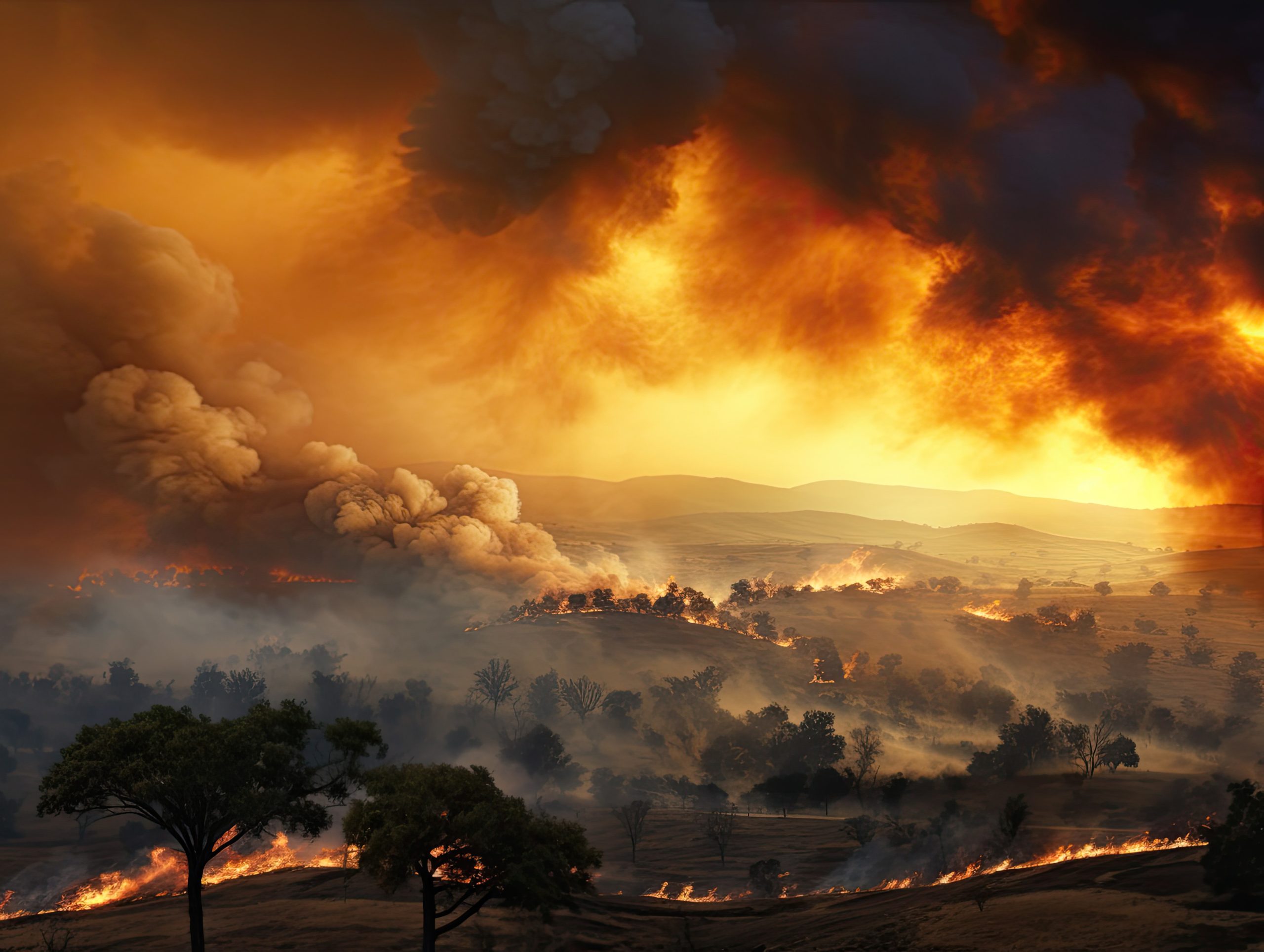
A lightning strike doesn’t announce itself. It hits, it smolders or it catches, and within hours the Bureau of Land Management is putting out a press release describing fast-moving fire behavior on federal land nobody was watching closely enough.
That’s how the Kane Springs Fire started, discovered just before noon on a Wednesday in early June, roughly 17 miles southwest of Caliente in Lincoln County. By that Thursday morning, it had burned 6,000 acres of short grass and brush. A second fire, the Grapevine, ignited the same way in the Clover Mountain Wilderness Area about 10 miles southeast of Caliente, and had already consumed nearly 4,000 acres.
Three weeks later, as of Friday, June 26, those two fires had burned more than 41,000 acres combined. The Grapevine Fire alone, sitting at 24,047 acres, remained completely uncontained. The Kane Springs Fire had reached 50 percent containment after weeks of effort. Beaver Dam State Park, caught in the path of the Grapevine Fire, remains closed indefinitely.
This is what Nevada’s fire officials warned was coming back in the spring, when snowpack readings across the Great Basin came in at 10 to 30 percent of normal and a warmer-than-average winter left fuels across the region drying out four to six weeks ahead of schedule. The warning wasn’t abstract. It was a forecast for exactly this.
Tracking the Growth
The numbers tell a story of fires that have consistently outpaced the resources thrown at them, at least in the early going.
By June 18, the two fires combined had grown to roughly 11,000 acres, with containment efforts still in their earliest stages. Four days later, by June 21, the Kane Springs Fire had grown to 12,448 acres at just 10 percent contained, while the Grapevine Fire had reached 11,607 acres with zero containment. BLM officials described dry fuels, steep slopes, and persistent winds challenging suppression efforts, particularly near the head of the fire where hotshot crews, hand crews, helicopters, and Single Engine Air Tankers were working to slow the advance.
By June 23, containment on Kane Springs had grown to 25 percent, but the Grapevine Fire kept expanding. Within another 24 hours, that fire had jumped roughly 25 percent in a single 18-hour stretch, reaching 23,188 acres. Combined, the two fires crossed 40,000 acres that week, a milestone that established the Grapevine Fire as the state’s largest wildfire of 2026.
By Friday, June 26, the combined total reached 41,089 acres. Kane Springs had finally crossed the 50 percent containment threshold. Grapevine remained at zero.
That zero-percent figure deserves attention. A fire that has burned 24,000 acres and still has no established containment line means firefighters haven’t yet found a way to box in even a portion of its perimeter. Every acre burned is still actively expanding the fire’s edge, with no confirmed boundary holding it back.
Why the Grapevine Fire Won’t Cooperate
The terrain explains most of the difficulty. The Grapevine Fire is burning through the Clover Mountain Wilderness Area, a landscape of heavy timber across steep, rugged canyons that makes ground access extraordinarily difficult even under ideal conditions. Federal officials have repeatedly described the fire’s behavior using language that signals serious danger to firefighting crews: running fire, torching, and spotting observed in steep and difficult-to-access terrain.
Each of those terms describes a distinct and dangerous fire behavior. Running fire means flames are moving rapidly along the ground, often faster than crews can safely track or contain. Torching describes individual trees or clusters of vegetation igniting explosively, often sending flames well above the main fire line. Spotting is perhaps the most operationally frustrating behavior of all: embers carried by wind landing far ahead of the fire’s main perimeter, starting entirely new ignition points that crews then have to address as if they were separate incidents.
Combine those three behaviors with steep canyon terrain that limits where heavy equipment like dozers can even operate, and you get a fire that resists the standard playbook. Crews have instead relied on natural road breaks and natural barriers, along with helicopters and air tankers dropping retardant, to slow spread in areas where ground crews simply cannot safely work.
The Kane Springs Fire, by contrast, has burned primarily through short grass and brush rather than heavy timber, which explains why containment progress there has moved more steadily, climbing from 10 percent to 25 percent to 50 percent over the same three-week stretch where Grapevine has stayed essentially uncontained.
The Conditions Driving Everything
None of this growth happened in a vacuum. Nevada’s fire officials had been warning since spring that 2026 carried elevated wildfire risk tied directly to drought conditions and an unusually warm winter that left mountain snowpack at a fraction of normal levels.
That early dryness compounded throughout spring and into June. By the time the Kane Springs and Grapevine fires ignited, fuels across the Great Basin region were described as nearing record dry levels. Add the sustained Red Flag Warning conditions that have repeatedly hit Southern Nevada throughout June, gusty winds combined with single-digit humidity, and you get a fire environment where suppression crews are working against conditions that actively favor fire spread over containment, day after day.
Officials specifically noted that overnight recovery, the natural cooling and humidity increase that typically happens after dark and gives firefighters a window to make containment progress, has not been sufficient to meaningfully slow these fires. Normally, fire behavior calms somewhat overnight as temperatures drop and humidity rises, giving crews a chance to build and reinforce containment lines before the next day’s heat and wind return. When that overnight recovery period weakens or disappears, as it has during this stretch, fires essentially stay active around the clock, denying crews their usual tactical advantage.
The Resource Strain
Roughly one-third of all active national fire personnel are currently deployed to the Great Basin region specifically to manage these incidents, according to federal fire tracking data. That’s an extraordinary concentration of national firefighting resources pointed at a single region, and it reflects how seriously fire officials are treating this early-season activity.
Hundreds of personnel have cycled through both fires over the three-week period. Engines, dozers, hotshot crews, helicopters, and air tankers have all been deployed, with crews working to establish containment lines using whatever natural advantages, road systems, previous burn scars, ridgelines, the terrain offers them.
That resource commitment carries an opportunity cost that matters beyond Lincoln County. Fire season in the broader Western United States typically intensifies through July and August. Personnel and equipment tied up fighting Nevada fires in late June are personnel and equipment not available if fires break out elsewhere in the region during the peak summer months still ahead. Fire officials have been explicit that this season arrived four to six weeks ahead of the normal schedule, which means the resource strain question isn’t hypothetical. It’s already playing out in real time, with the traditionally busiest months of the fire season still to come.
What’s Actually at Risk
No evacuations have been ordered in connection with either fire, a detail officials have repeated consistently throughout the three-week period. Lincoln County is sparsely populated, and the fires are burning primarily across federal BLM land and wilderness area rather than through residential areas.
That doesn’t mean the risk is purely environmental. A structure protection group has been established near the town of Barclay specifically because of the Grapevine Fire’s continued uncontained growth, a precautionary measure that puts resources in position before any structures are actually threatened rather than scrambling to respond after the fact. Beaver Dam State Park’s closure represents a direct, if lower-stakes, impact on public recreation access in the region.
The smoke impact extends further than the fire perimeters themselves. Southern Utah air quality has been affected by smoke drifting from these two Nevada wildfires, with health officials in that state issuing guidance about potential respiratory impacts for residents downwind. That regional smoke transport illustrates something important about wildfire impact generally: the consequences of a fire rarely stay confined to the county or even the state where it ignited.
The Early Warning That Came True
What makes this particular fire season notable isn’t just the acreage, though 41,000 combined acres from two fires represents serious fire activity by any measure. It’s that fire officials predicted this exact scenario months in advance and were right.
The warm winter, the deficient snowpack, the early arrival of critically dry fuel conditions, all of it was documented and publicized before a single acre burned. When the Kane Springs and Grapevine fires ignited from lightning strikes in early June, they landed in exactly the kind of pre-stressed fuel environment officials had been describing as a serious risk since spring.
That predictive accuracy matters for how seriously to take ongoing fire risk warnings for the remainder of 2026. If conditions were dry and dangerous enough in June to produce a 41,000-acre fire complex with one blaze still completely uncontained after three weeks, the trajectory into the historically more active months of July and August deserves serious attention from anyone living in or traveling through the broader Great Basin region.
For Las Vegas specifically, sitting roughly 125 miles southwest of these fires, the direct threat remains limited. But the broader pattern, early fire season arrival, persistent Red Flag conditions, smoke that travels well beyond fire perimeters, and a resource base already stretched thin this early in the season, is exactly the kind of regional fire environment that has increasingly defined Southern Nevada summers in recent years.
The Grapevine Fire’s status as the state’s largest wildfire of 2026, recorded in late June with peak fire season still ahead, is not a comforting superlative. It’s a marker worth remembering as the calendar moves toward July and August.
Key Insights
The Grapevine Fire’s persistent zero percent containment after three weeks and 24,000-plus acres burned, contrasted against Kane Springs Fire’s steady progress to 50 percent containment in similar conditions, demonstrates how terrain type, heavy timber and steep canyons versus open grass and brush, fundamentally determines suppression difficulty independent of resources deployed.
The deployment of roughly one-third of all active national firefighting personnel to the Great Basin region this early in the season creates resource strain risk for the remainder of summer 2026, when historical fire activity typically peaks well above current June levels.
Smoke from these fires reaching Southern Utah and affecting air quality there illustrates that wildfire consequences extend well beyond the immediate fire perimeter and county lines, creating regional rather than purely local public health considerations.
Fire officials’ spring predictions of an early, severe fire season tied to deficient snowpack and warm winter conditions proved accurate within weeks, suggesting continued elevated risk warnings for the traditionally busier July and August period deserve serious weight.
Sources
FOX5 Vegas 41,000 Acres Coverage
8 News Now Wildfire Growth Tracking
News3 Las Vegas Containment Update
KOLO Fire Growth Report
Cornea WildFire Explorer Nevada