



A Change of Command That Made History
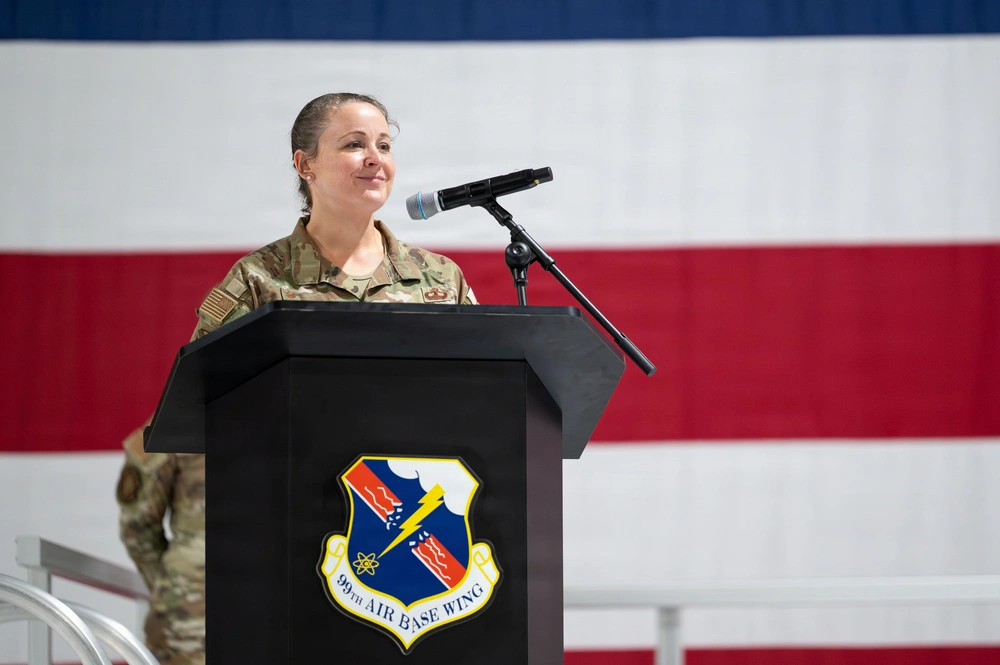
On July 17, 2026, a ceremony took place at Nellis Air Force Base that the base’s 80-year history had never seen before. Col. Christine Littlejohn officially assumed command of the 99th Air Base Wing at Nellis Air Force Base, becoming the first woman to lead the wing. The 99th Air Base Wing is the host unit at Nellis, responsible for the installation support that allows every other mission at the base to function. Becoming its commander means holding responsibility for one of the U.S. Air Force’s most operationally significant installations.
Nellis is not a routine assignment. It is home to the Thunderbirds, the Air Force’s premier aerial demonstration squadron that returned to Las Vegas’s skies just weeks before Littlejohn’s command ceremony for the America250 flyover. It hosts the Air Force Warfare Center, which conducts advanced tactical training for pilots from across the service. The Nevada Test and Training Range adjacent to the base is one of the largest military airspace complexes in the world. The missions flowing through Nellis on any given day represent the cutting edge of American air power development and readiness.
Littlejohn’s assumption of command over this environment is a milestone that carries weight beyond biography. It reflects how the Air Force has evolved institutionally, what Las Vegas’s relationship with its military neighbor looks like in 2026, and what leadership succession means at the intersection of service and community.
The Career Behind the Command
Understanding what brings someone to wing command at Nellis requires understanding the Air Force’s selective and demanding path to senior leadership. Wing commanders at major installations are typically colonels with two decades or more of progressive responsibility, multiple deployments, advanced professional military education, and the kind of operational and organizational track record that sustains throughout a career rather than spiking in any single assignment.
Littlejohn’s path to Nellis reflects this pattern while carrying the additional distinction of navigating a career in an institution that has historically been male-dominated at senior levels. The Air Force has made deliberate efforts over the past two decades to ensure qualified women advance to senior positions on merit rather than being filtered out by institutional barriers. Littlejohn’s command represents both the success of those efforts and the continued recognition that firsts still matter because they demonstrate what’s possible for the next generation of officers behind her.
Col. Littlejohn carries on generations of military service in both the literal and figurative sense. Her personal family history connects to military tradition in ways that ground her command in something beyond individual achievement. The Las Vegas Review-Journal’s coverage emphasized this generational dimension, framing her command assumption not just as a professional milestone but as a chapter in a longer family story of service that now includes leading one of the Air Force’s premier installations.
Nellis and Las Vegas: A Civilian-Military Partnership
The relationship between Nellis Air Force Base and Las Vegas is older than the modern city itself. The installation was established in 1941, predating the casino corridor development that would define Las Vegas’s global identity in the postwar decades. For most of that time, Nellis and the Las Vegas metropolitan area have coexisted in a relationship that involves economic interdependence, community partnership, and the shared identity of a military town that happens to be one of the world’s most famous tourist destinations.
The Thunderbirds are the most visible expression of this relationship. As we covered in our earlier article on the America250 flyover, the demonstration squadron genuinely claims Las Vegas as its hometown in ways that create civic pride distinct from the entertainment economy’s contributions to the city’s identity. Nellis’s pilots train in Las Vegas skies. Their families live in Las Vegas neighborhoods. Their spending supports Las Vegas businesses. The base’s workforce, military and civilian combined, represents one of the region’s largest employers.
Littlejohn’s command positions her as the military’s senior installation leader in this relationship. Wing commanders interact regularly with local elected officials, community organizations, and civic leaders. They represent the Air Force in public forums, manage the base’s community relations, and steward relationships that affect everything from noise complaint management to partnership on emergency response.
In a city that has been building its sports and entertainment identity with unprecedented speed, having senior military leadership that understands both the base’s mission requirements and the community’s evolving character matters for maintaining the mutually beneficial relationship that Nellis and Las Vegas have sustained for eight decades.
The 99th Air Base Wing’s Mission
The 99th Air Base Wing’s role is foundational rather than visible. It doesn’t fly combat missions or conduct tactical training directly. It provides the installation support that allows the units doing those things to function: infrastructure maintenance, security forces, civil engineering, medical services, communications, logistics, and the dozens of other functions that a major military installation requires to operate.
Leading the 99th means managing this support enterprise at scale while coordinating with the multiple major commands and tenant units that share Nellis. The Air Force Warfare Center, the Thunderbirds, and the various squadrons conducting advanced training all depend on the 99th’s services to execute their missions. Wing command at this level is fundamentally a general management role with a military context, requiring the organizational leadership capability to integrate diverse functions toward institutional mission success.
The complexity of this role is one reason why wing command is considered a significant career milestone in the Air Force. Officers who successfully command wings at major installations demonstrate the organizational capacity that translates into potential general officer selection, the next tier of senior military leadership.
Women in Air Force Senior Leadership
Littlejohn’s historic command at Nellis arrives during a period of continued, if uneven, progress for women in Air Force senior leadership. The service has had women generals and admirals, women command senior enlisted leaders, and women in a range of combat and operational roles that were closed to them not many decades ago. But firsts at specific prestigious positions continue to occur, indicating that complete integration at all leadership levels is still in progress rather than complete.
The Air Force’s approach to this evolution has been deliberate without being prescriptive. The service tracks demographic representation in leadership pipelines without mandating outcomes, pursuing the goal of ensuring that the full pool of qualified talent can compete for and reach senior positions without artificial barriers. When a qualified officer who happens to be the first woman to command a particular wing earns that command, it validates both the officer’s capability and the pipeline that prepared her.
For the Las Vegas community, Littlejohn’s command also demonstrates something about the region’s connection to military excellence. Nellis has been assigned some of the Air Force’s most capable officers across its history. The assignment of a history-making wing commander reflects continued confidence in the base’s importance and the community’s capacity to receive and support senior military leadership.
The July 17 Ceremony
Change of command ceremonies in the military carry specific meaning beyond administrative formality. They represent the transfer of authority, accountability, and trust that military unit command embodies. The outgoing commander relinquishes authority. The incoming commander accepts it. The formation of assembled personnel witnesses and validates the transfer. The ceremony’s traditional elements connect individual transitions to institutional continuity that extends across the service’s history.
When Littlejohn accepted command of the 99th Air Base Wing on July 17, she stepped into an unbroken chain of command authority that runs from Nellis’s establishment in 1941 through every commander who has led the installation since. The fact that she is the first woman in that chain doesn’t diminish the chain. It extends it into a chapter that was not possible before the institution evolved to where it is today.
For the Las Vegas community watching from outside the wire, the command ceremony represented something accessible: a moment of civic pride in the military installation that has been part of the city’s fabric for eight decades, now led by someone who made history by being the best qualified officer for the job.
Notes for Stakeholders
Col. Littlejohn’s command assumption offers insights for anyone working in organizational leadership, diversity in institutional roles, or civilian-military community relations:
Firsts at senior leadership positions still matter even in institutions with decades of integration efforts. The continued occurrence of historic firsts at prestigious positions indicates ongoing progress rather than completed transformation, giving each milestone significance for the talent pipeline behind it.
Wing command at major military installations requires general management capability that translates across organizational contexts. The 99th Air Base Wing’s support mission complexity mirrors the operational complexity of large civilian organizations, making military senior leadership experience directly relevant to business and civic leadership.
Civilian-military community relationships require active stewardship at the installation leadership level. Wing commanders are the face of their installations in community relations, making the character and capability of base leadership directly relevant to the quality of the partnership between military and civilian communities.
Generational continuity of service provides institutional depth that individual achievement alone cannot. Littlejohn’s family history of military service grounds her command in tradition while her historic position opens tradition to new possibilities.
Institutional evolution at senior levels requires both merit-based selection and pipeline development that ensures qualified candidates can reach selection. The Air Force’s approach demonstrates how large institutions can pursue representational goals without compromising quality standards by investing in the pipeline rather than mandating outcomes.
The Base and the City
Nellis Air Force Base and Las Vegas have grown up together over eight decades. The base predates the Strip’s casino towers, the arena complex that houses the Golden Knights and Aces, the Sphere, and every other landmark that defines the modern city. Through all of that growth, Nellis has remained a constant presence in the valley, its aircraft visible in the sky above subdivisions and resort corridors alike, its personnel integrated into the community’s schools, churches, businesses, and neighborhoods.
Col. Christine Littlejohn now leads that installation through whatever comes next: continued extreme heat that affects base operations, the autonomous vehicle and technology development happening around the base’s airspace, the sports franchise expansion that is reshaping Las Vegas’s civic identity, and the ongoing national security missions that Nellis has always been primarily about.
She is the first woman to hold this command. She won’t be the last. And that trajectory, from first to simply one of many across the course of time, is exactly what institutional progress looks like when it’s working.
Key Takeaways:
- Col. Christine Littlejohn assumed command of the 99th Air Base Wing at Nellis Air Force Base on July 17, 2026, becoming the first woman to lead the wing in the installation’s eight-decade history
- The 99th Air Base Wing is the host unit at Nellis, providing installation support services that enable all other missions at one of the Air Force’s most operationally significant bases
- Nellis is home to the Thunderbirds, the Air Force Warfare Center, and multiple advanced tactical training programs, making wing command there a prestigious and operationally significant leadership position
- Littlejohn’s command reflects both her individual career achievement and the Air Force’s continued, if uneven, progress on integrating women into senior leadership positions across all installation types
- The Nellis-Las Vegas relationship spans eight decades of economic interdependence, community partnership, and shared civic identity that wing commanders actively steward through regular engagement with local officials and organizations
- Wing command at major installations is considered a significant Air Force career milestone that demonstrates general management capability and positions officers for potential general officer selection
- Col. Littlejohn’s family history of military service grounds her historic command in generational tradition, a dimension emphasized in local coverage of the command assumption ceremony
- The command ceremony occurred just three weeks after the Thunderbirds’ America250 flyover over Las Vegas, connecting two significant Nellis-Las Vegas relationship milestones in quick succession
- The 99th Air Base Wing’s support mission complexity, integrating civil engineering, security forces, medical services, communications, and logistics at scale, mirrors organizational challenges of large civilian enterprises
- Littlejohn’s historic first continues a pattern at Nellis of assignments reflecting the installation’s importance within the Air Force, with each generation of wing commanders carrying the institution forward into new chapters