


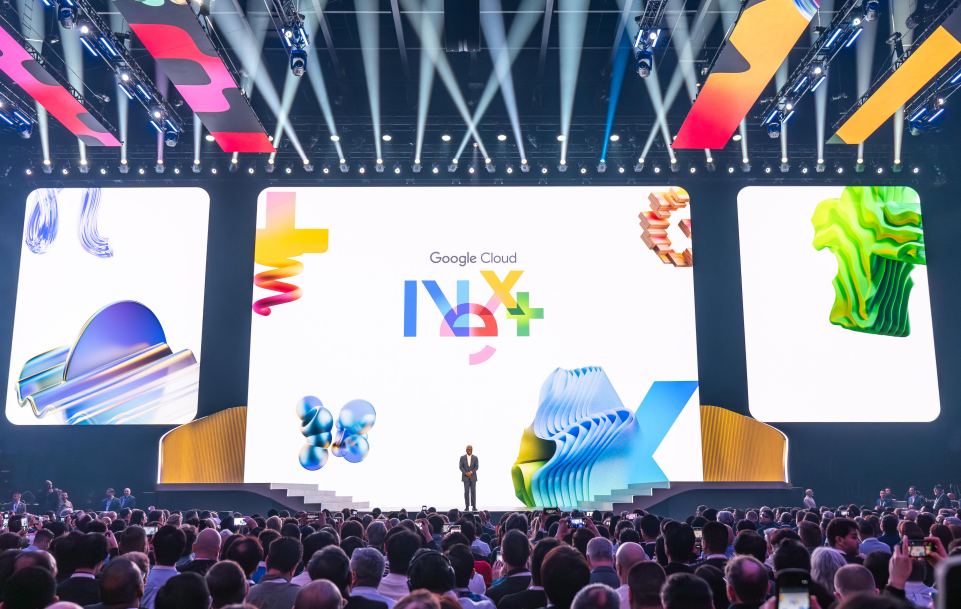
Las Vegas, April 22-24, 2026. Mandalay Bay Convention Center.
Thomas Kurian did not leave the experimental phase behind quietly. Google Cloud’s CEO opened the company’s annual conference at Mandalay Bay with a statement that set the tone for everything that followed over three days of product launches, customer case studies, developer announcements, and competitive positioning: the pilot era is over. The challenge now is scaling AI across the enterprise, and the question every organization in the room needed to answer was whether their current AI infrastructure was built to do that.
The answer Google was offering was its own: a vertically integrated stack running from custom silicon at the foundation through frontier models in the middle to enterprise applications at the top, with agents doing the work that connects the layers. Gemini, the branding that Google has consolidated most of its enterprise AI strategy under, was the common thread across the product announcements. But the real argument at Google Cloud Next 2026 was not about any specific product. It was about whether the strategy of controlling the full stack, chips to models to platform to applications, is the right bet to make when the enterprise AI market is still in the early innings of its long-term structure.
The Full-Stack Argument and Why It Matters
The enterprise AI market in 2026 is structured by a fundamental choice that every organization purchasing AI capability is making, whether they realize it or not: do you buy components and assemble them into a system, or do you buy a system and configure it to your needs?
Kurian’s argument at Next 2026 was explicit about which choice Google is betting on. He contrasted Google’s approach with rivals, saying they offer components rather than a complete platform. A customer who purchases compute from AWS, models from Anthropic, orchestration from a third party, and application integration from another vendor is assembling a system from components. A customer who uses Google’s stack gets Ironwood TPU compute, Gemini models, the Gemini Enterprise Agent Platform for orchestration, and Workspace for application integration, all from one vendor with designed interoperability at every layer.
The investment figure that Sundar Pichai cited at the conference is the most concrete evidence of how seriously Google is betting on this strategy. Capital expenditure of approximately $185 billion in 2026, up from $31 billion four years earlier, represents a six-fold increase in infrastructure investment over four years. That is not the investment pattern of a company that expects to compete on the margins of the enterprise AI market. It is the investment pattern of a company that expects the enterprise AI infrastructure market to be worth competing for at full commitment.
Google reported the fastest growth of the three major hyperscalers in Q4 2025, at 50 percent year over year, which Kurian presented as validation of the full-stack approach. It is worth noting that growing quickly from a smaller base is mathematically easier than growing quickly from a larger one, and Google Cloud remains third in cloud market share behind AWS and Microsoft Azure. The growth rate is genuinely impressive. The competitive gap it needs to close before the integrated stack argument is validated by market position rather than growth rate is also genuinely large.
The Gemini Enterprise Agent Platform and What Happened to Vertex AI
The most significant organizational change in Google’s product lineup at Next 2026 is the consolidation that turned Vertex AI and Agentspace into a single product called Gemini Enterprise Agent Platform, with the enterprise product suite folded into Gemini Enterprise.
The renaming is not just cosmetic. Vertex AI was Google’s machine learning platform for developers and data scientists, and it carried the technical reputation of a serious infrastructure product without the enterprise accessibility of a product that could be sold to CIOs and business buyers. Agentspace was the enterprise search and knowledge management product that gave organizations access to Google’s models applied to their own data.
Combining them under the Gemini Enterprise brand reflects the strategic bet that the enterprise AI market will converge around agents that combine model intelligence with enterprise data access, and that the developer tool and the enterprise product are increasingly the same thing rather than adjacent things serving different buyers. A developer building an agent on Gemini Enterprise Agent Platform and an enterprise buyer deploying agents for their workforce are both using the same infrastructure, and the distinction between them matters less as agents become the primary user interface for enterprise AI.
Model Garden, the catalog within the platform, has grown to over 200 models, including not just Google’s own Gemini and Gemma family but also third-party models including Anthropic’s Claude and Meta’s Llama. This is an interesting competitive dynamic: Google is competing with Anthropic for enterprise AI customers while simultaneously offering Anthropic’s models through its own platform, which gives enterprise customers who want Claude the option of running it within Google’s governance and security infrastructure rather than through Anthropic’s API directly. The model catalog strategy positions Gemini Enterprise as a platform play rather than a model play, similar to the Bedrock strategy AWS has executed.
Workspace Studio and the No-Code Agent Builder
Workspace Studio is the product announcement at Next 2026 most likely to have immediate organizational impact at the 90-day horizon rather than the 12-month horizon.
The premise is direct: employees who use Gmail, Docs, Sheets, Drive, Meet, and Chat can build AI agents for their own workflows using plain-language instructions, without requiring developer involvement. The agents connect to third-party applications including Asana, Jira, Mailchimp, and Salesforce, which covers the workflow tools that most knowledge workers spend significant time in.
The organizational implication is significant. Most organizations that have been deploying AI capabilities have done so through centralized IT or data science teams that build tools for business users. This approach concentrates the bottleneck: the rate at which the organization can deploy useful AI is limited by the capacity of the development team, not by the organizational appetite for AI-assisted work.
Workspace Studio decentralizes the bottleneck by making agent creation accessible to the employees who have the deepest understanding of their own workflows. A marketing manager who understands exactly what a competitor monitoring workflow should do, or a supply chain analyst who knows which data sources a procurement agent needs to check, can build that agent without waiting for a developer to prioritize it. The quality and sophistication of what non-technical employees can build is lower than what a developer can build, but the deployment speed and the organizational coverage are dramatically higher.
Kurian’s framing of this dynamic at the keynote, that employees should become AI builders, is a cultural aspiration as much as a product announcement. The organizations that have moved fastest in enterprise AI adoption are the ones where the belief that AI capability is a technical specialty has been replaced by the belief that deploying AI for your own work is a professional skill that any knowledge worker can develop.
The Agent-to-Agent Protocol and the Open Standards Question
Google’s Agent2Agent protocol, known as A2A, reached a significant maturity milestone at Next 2026: production deployment at 150 organizations and governance transfer to the Linux Foundation.
A2A handles agent-to-agent communication: the coordination protocol that allows agents built on different platforms to collaborate on tasks that require multiple agents with different capabilities. Anthropic’s Model Context Protocol, MCP, handles agent-to-tool connections: the standard through which an agent accesses external data sources and services. The two protocols address different layers of the agent architecture, and they are designed to be complementary rather than competitive.
The Linux Foundation governance transfer is the signal that Google is treating A2A as an infrastructure standard rather than as a Google-controlled technology. Infrastructure standards governed by neutral organizations attract adoption from organizations that are reluctant to build on standards controlled by a competitor. The Linux Foundation’s record with standards like Linux, Kubernetes, and OpenTelemetry gives it credibility as a neutral governance body, and A2A’s adoption by 150 organizations at production scale before the governance transfer is the evidence that the standard has already moved past the pilot phase.
Google’s managed MCP servers, alongside the Apigee bridge that converts standard APIs into agent tools, are the complementary infrastructure that makes the protocol ecosystem practical for enterprise deployment. A protocol is only as useful as the tooling that makes it deployable, and Google is investing in both the standard and the infrastructure that makes the standard accessible to organizations that cannot build MCP servers from scratch.
Project Mariner, Google DeepMind’s web-browsing agent, scored 83.5 percent on WebVoyager, the benchmark that measures an agent’s ability to navigate the web to complete tasks. The benchmark score is not itself the product announcement, but it represents the state of the art in autonomous web navigation at the time of Next 2026. The planned visual builder, cross-device sync, and agent marketplace for Mariner describe a product trajectory that extends the web-browsing capability into a platform for agents that interact with the existing web rather than requiring web services to build new APIs.
Customer Deployments That Ground the Platform Claims
Conference keynotes in the enterprise technology industry have a well-established relationship with reality: the customer case studies that keynote presentations select are the best available evidence for the claims being made, and they are selected because they are the best available evidence, not because they are typical.
With that context noted, the specific deployments cited at Google Cloud Next 2026 are worth examining for what they reveal about where agentic AI actually delivers value at enterprise scale.
Virgin Voyages built “Rovey,” a customer-facing AI concierge for cruise guests, using Google Distributed Cloud Edge. The deployment addresses a genuinely difficult technical constraint: cruise ships have limited and variable connectivity, and a customer AI service that requires reliable cloud connectivity is not usable in the environment where cruise guests need it. Google Distributed Cloud Edge runs AI inference at the edge rather than requiring round-trip cloud connectivity for every interaction. The Rovey deployment is evidence that the edge infrastructure can sustain conversational AI in environments where cloud connectivity is unreliable, which is a specific and real constraint that many deployment contexts face.
Walmart’s Gemini Enterprise deployment for store and supply chain leaders illustrates the enterprise knowledge access use case: employees who need to access business data to make operational decisions can query that data through a conversational interface rather than through the combination of SQL queries, report requests, and business intelligence dashboard navigation that most large-enterprise data access currently requires. Walmart’s planned extension to a customer-facing shopping tool is the logical next step, but the internal deployment is the one with the proven operational value.
Danfoss’s automation of 80 percent of transactional email order decisions, and Suzano’s 95 percent reduction in SQL query time for 50,000 employees, are the numbers that CFOs pay attention to because they describe productivity changes of the magnitude that justify the investment required to build enterprise AI capability at scale.
The Competitive Positioning at Next 2026
Google Cloud Next 2026 occurs in a competitive environment where every hyperscaler is making an agent infrastructure bet and where the enterprise buyer has more options than in any previous year. Understanding how Google is differentiating its approach requires understanding what the alternatives offer.
AWS’s Bedrock AgentCore, announced at AWS re:Invent, emphasizes governance and the multi-model strategy: a platform where any model can be deployed with consistent security controls, and where Cedar provides declarative policy specification for agent behavior. AWS’s differentiator is the breadth of its model marketplace and the maturity of its enterprise governance infrastructure.
Microsoft’s Copilot, embedded across the Microsoft 365 suite, has the distribution advantage of an installed base that reaches essentially every enterprise knowledge worker who uses Microsoft productivity software. The Microsoft approach does not require enterprise buyers to make a new infrastructure decision: Copilot is delivered through the software relationship that already exists. Google’s Workspace, with a smaller market share than Microsoft 365 in the enterprise, does not have the same distribution advantage, which makes Workspace Studio’s decentralized agent-building capability a potential differentiator rather than a natural extension of existing penetration.
Oracle’s NetSuite Next, also announced in October 2026, applies the agent infrastructure argument specifically to mid-market ERP: AI as the operational layer through which the platform surfaces information and facilitates action. Oracle and Google are not direct competitors in the same market segments, but the agent infrastructure argument they are both making is structurally similar, which suggests that the underlying bet about how AI changes enterprise software is converging across vendors with different starting positions.
Key Takeaways
Google Cloud Next 2026’s organizing claim is that the full-stack approach, controlling chips, models, platform, and applications, produces better enterprise AI outcomes than assembling components from multiple vendors. The claim is consistent with the product architecture Google unveiled at the conference, and it is consistent with the investment commitments Pichai cited. Whether it is consistent with enterprise buying behavior will take several years to determine.
The renaming of Vertex AI and Agentspace to the Gemini Enterprise Agent Platform is a strategic consolidation that reflects Google’s belief that the enterprise AI market will converge around agents rather than remaining divided between developer infrastructure and enterprise applications. Organizations evaluating Google Cloud infrastructure should understand the Gemini Enterprise umbrella as the framework within which new product capabilities will be added.
Workspace Studio is the product most likely to produce near-term ROI for Google Workspace customers. The no-code agent builder that allows knowledge workers to automate their own workflows within familiar tools reduces the deployment bottleneck that has slowed enterprise AI adoption in organizations where development capacity is the constraint.
The A2A protocol’s Linux Foundation governance makes it a safer bet as an infrastructure standard for organizations concerned about vendor lock-in in their agent communication layer. The production deployment at 150 organizations provides the adoption evidence that early-stage protocols lack.
The competitive context for Google Cloud is third place in a three-way race for enterprise cloud infrastructure, with the fastest growth rate among the three. How much of that growth is attributable to the agent infrastructure bets announced at Next 2026, and how much to the structural dynamics of cloud market expansion, will be clearer at Next 2027.
Notes for Enterprise Technology Leaders
Google Cloud Next 2026 is held in April, earlier in the year than AWS re:Invent’s November-December window and than Oracle AI World’s October timing. For organizations managing annual technology planning cycles, the April timing creates a different planning context: Google’s Next announcements inform Q2 and Q3 evaluation processes, while AWS and Oracle announcements inform Q4 and the following year’s budget planning.
For organizations currently running Vertex AI or Agentspace: the consolidation into Gemini Enterprise Agent Platform is primarily a naming and branding change. Existing deployments continue to function, and the product capabilities that were available under the previous names are available under the new name. The significance for procurement and vendor evaluation is that future capability additions will be framed within the Gemini Enterprise context rather than the Vertex AI context.
For organizations evaluating agent infrastructure standards: the A2A and MCP protocols represent two layers of the agent communication stack, and both are relevant to organizations building multi-agent systems. A2A governs how agents coordinate with each other. MCP governs how agents connect to tools and data sources. Building on both, rather than treating them as alternatives, is the architecture that the protocol sponsors describe as the intended deployment pattern.
Workspace Studio availability for business, enterprise, and education customers at Next 2026’s announcement timing means that Google Workspace customers can evaluate the no-code agent builder without waiting for a separate procurement process. The evaluation question is whether the agents that knowledge workers build using Workspace Studio deliver enough productivity value to justify the change management investment in training employees to use the tool.
The Mandalay Bay Convention Center’s location on the south end of the Las Vegas Strip places Next 2026 at a remove from the Venetian Expo and Caesars Forum cluster that anchors AAPEX, Oracle AI World, and Money20/20. For attendees combining Next with other Las Vegas conferences during a technology-heavy spring travel schedule, the shuttle and monorail connections between the south Strip properties and the Venetian are the logistics consideration that planning should account for.
Google Cloud Next 2026 ran April 22-24 at the Mandalay Bay Convention Center in Las Vegas. For the session library, product documentation, and Gemini Enterprise resources, visit cloud.google.com/next.