


Six and a half ounces. That’s it.
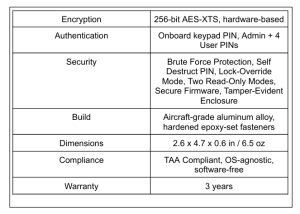
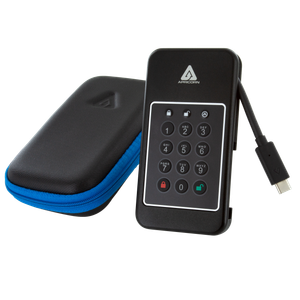
Housing crafted from aircraft-grade aluminum. You can tell it is built to last and quality is something that is taken seriously at every step in the process. Tamper-resistent fasteners driven and cemented with hardened epoxy. If someone tries to physically crack it open you will know. The data inside will remain safe, and stay completely inaccessible to them. Let’s look at the keypad.
The surface is a polymer-coated membrane. It’s built to be wear resistant. That makes a massive security difference considering a keypad that shows wear is like having your PIN code written on the back of your debit card. Apricorn saw the security risks and built around it. This is the kind of quality and attention that shows up consistently in every corner of this product. The Apricorn Aegis NVX. 500 gigabytes. Hardware-encrypted NVMe. External drive. Retails on their website for $569 which you realize is a bargain for what you are buying.
What Is Being Said At Money2020 About The Apricorn Aegis NVX
Money2020 USA draws roughly 13,000 people every October to Las Vegas. It’s a high-level audience for a product like this. Financial services executives, fintech founders, payments infrastructure people, the CTOs and CISOs of companies processing billions of transactions. This is not a casual crowd. These are leaders whose organizations get audited, regulated, and, unfortunately, occasionally breached, and they think about data security the way most people think about weather: constantly, quietly, and with a nagging awareness that if they ignore the risks it will go badly.
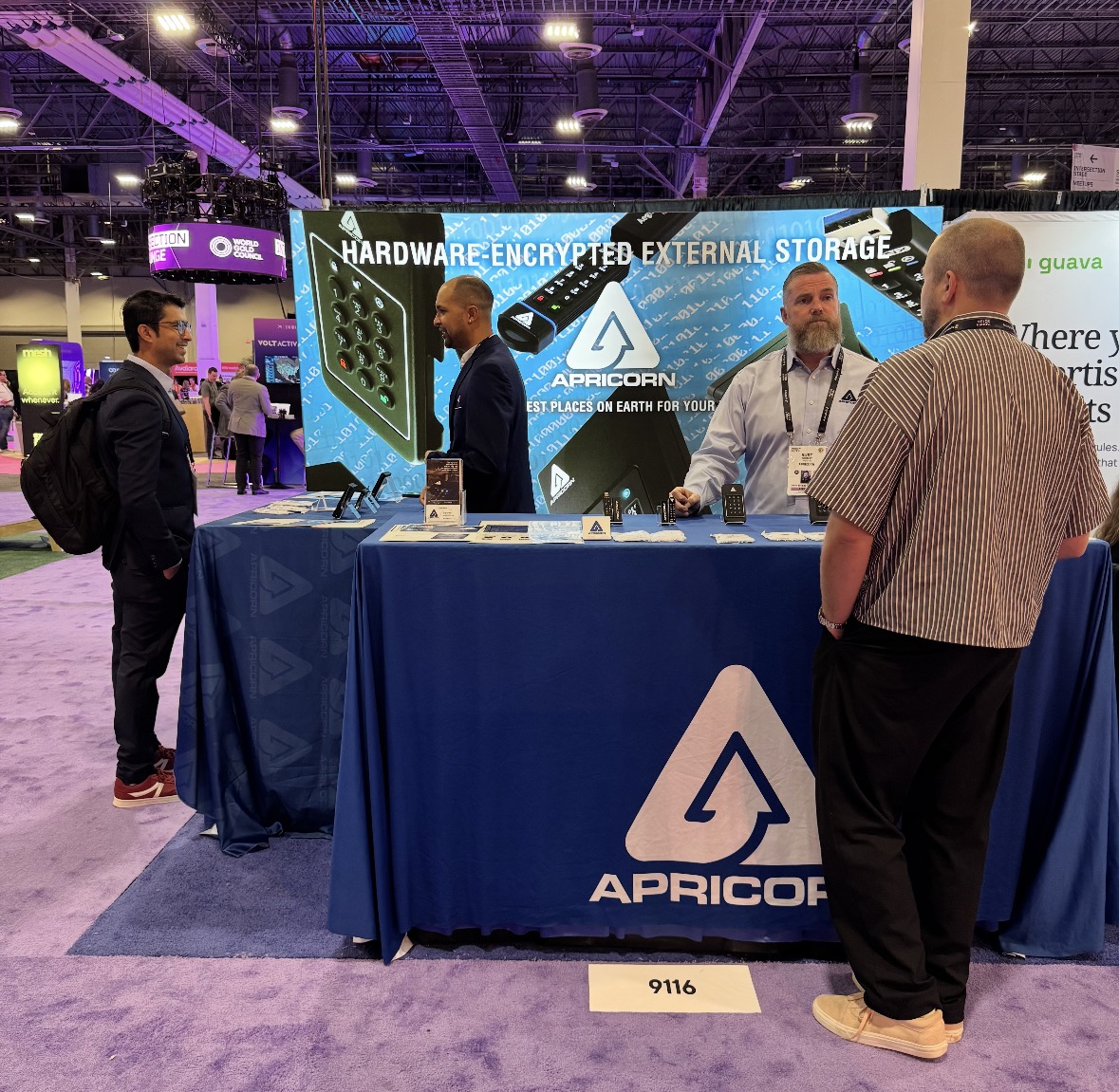
Apricorn had a presence at Money2020 this year, and it made sense. The conversations happening in the meeting rooms, the expo hall floors, at lunches, dinners and over drinks are exactly the kind where hardware-encrypted storage becomes a real line item rather than a theoretical consideration. Compliance officer from a regional bank. CISO from a payment processor. Federal contractor whose work falls under CMMC requirements. None of these people need to be convinced that data security matters. They need to be shown a specific solution to a specific architectural problem that most of the industry is quietly ignoring, and the Aegis NVX is that solution.
What the Money2020 crowd understands better than most is that the cost of an unencrypted device going missing is not the cost of the device. It is the cost of everything, and anything, that will happen next. Regulatory notification timelines. Legal review. Potential fines. Customer notification requirements. The reputational fallout in industries where trust is the product. When measuring against that backdrop, whether to spend $569 on an encrypted device is more of a risk management decision and not a mere purchase. When you run the math vs the risk management it’s not even close.
What Hardware Encryption Actually Means
Most people running encrypted storage are running software encryption. That includes the disk encryption baked into Windows, Mac, and every major operating system. It works, for the most part. There is a structural problem though that is important to understand, and, in fact, it cannot be “engineered away”. That remains true no matter how good the software gets. When a drive is in use, the key has to live somewhere, so it resides in the host machine’s RAM. Sophisticated hackers with access to that computer go hunting for the key, find it, and use it. This has been documented in real forensic contexts. It’s just how the architecture works, and it is a limitation that no software update can fully resolve because it is in the design. That’s not going to be solved with code or software. The Aegis NVX operates differently.
The key stays inside the device. Authentication happens inside the drives, and so does the encryption. The computer it connects to gets access to unlocked storage and nothing else. It never gets near the key. There is nothing in the RAM to extract. When the drive is disconnected – the data is inaccessible again immediately, with no lingering session state to exploit. The cipher is 256-bit AES-XTS, which is the same specification the U.S. government mandates for SECRET-level classified material. XTS mode was developed specifically to close vulnerabilities in earlier AES implementations that left encrypted storage exposed to certain attacks on the ciphertext. Here’s what that means for you:
No driver to install. No software. No account to create or password to reset through a web portal. Windows, Mac, Linux, Android, Chrome, Symbian: whatever platform you are running, this works with it. You connect it, type your PIN on the physical keypad, and you are in. That is the entire setup. The OS-agnostic design also matters in enterprise environments where device fleets run mixed operating systems and IT does not want to manage platform-specific software across all of them.
What the Drive Actually Does When Things Go Wrong
Start with the PIN structure.
There is one Admin PIN and four independent User PINs. The IT administrator sets up everything, hands the drive to a staff member, and never has to share admin credentials to do it. When that staff member is terminated, which eventually happens everywhere, the admin resets or wipes the drive without need the user’s PIN. When someone forgets their PIN, which also happens, the admin restores access without touching the underlying data. This sounds like basic, obvious functionality that any encrypted drive should have. Most encrypted drives do not actually work this way. Wrong PIN attempts are where it gets serious. Too many wrong entries in sequence and the device locks itself. Keep pushing past that threshold and it runs a crypto-erase, permanently destroying the encryption key. There is no call to make after that. No recovery process. No master password held somewhere by the manufacturer waiting to be subpoenaed or socially engineered out of an unsuspecting support rep. The data is gone. It’s like a shredded document at that point. This is exactly the outcome you have to design toward in a compliance environment. You don’t really have a choice. “The device was encrypted and the key has been destroyed” is a complete answer to a regulator. There is also another key feature which is something that Apricorn calls a “Self Destruct PIN”. The “Self Destruct PIN” is a specific code you configure separately that wipes the device clean the instant it is entered. Border situation. Physical compromise. Seized or stolen hardware. One entry and the drive reads as blank media to anyone who picks it up afterward. This does not normally come up in product conversations because the scenarios that require it are not ones people want to think about much less dwell on. It is there to keep the sensitive data safe, and not be compromised.
For workflows where the drive moves between trusted workstations repeatedly – there is a Lock-Override Mode that keeps the drive unlocked across those connections without requiring a PIN entry every time. It seems like a small thing on paper. In practice it is the difference between a security tool that gets used vs one that ends up in a drawer because it introduces enough friction that people route around it. Security tools that get routed around because of inconvenience create a different type of liability, and still have the look of a security tool. That’s a bad combination. If your work involves handling other people’s data – then, you can use the read-only options. The hardware read-only mode is admin-configured and it cannot be overridden at the user level regardless of what the user attempts to do. There is also a software read-only mode that users can set themselves within whatever parameters the administrator has established. Forensic investigator takes custody of a drive and plugs it in with zero mechanical possibility of accidentally altering the source media. If a compliance officer distributes documents that recipients can read but cannot modify. Both are real workflow needs in financial services and legal environments, and most encrypted drives handle them poorly if at all. Firmware on the device cannot be swapped or modified without authentication. This is crucial especially with artificial intelligence making attacks easier than ever before. Supply chain attacks targeting hardware at the firmware level have been documented enough in recent years to force treating them as a real threat as mandatory. Apricorn slams the door on this, so you don’t have to worry about it with this drive. One thing Apricorn says explicitly and has built into the hardware architecture itself: they cannot retrieve your data if the PIN is lost. No backdoor exists. The design does not include one. In a market where “no backdoor” frequently means “no backdoor we have disclosed or have been compelled to disclose” – that is not the case here. There is no back door. Period. At all. None. That is because the key never leaves the device and Apricorn never has access to it. It’s not a policy they can change next quarter and update at the flip of a switch. This is a hardware constraint. Your data remains encrypted and secure.
Who Actually Needs This at Money2020
The profile of the buyer at Money2020 is worth spelling out because it explains exactly why this product is the right one to bring to this conference. Financial institutions of almost any size operate under data protection requirements that treat unencrypted portable storage as a material risk. A lost drive with customer account data on it triggers notification obligations, potential regulatory action, potential civil suits, and usually ends with someone’s employment status changing. Hardware encryption with crypto-erase removes that risk category almost entirely. If the device is lost, the data is inaccessible, and the incident is reportable as a contained event which is a lot better than a breach.
Federal contractors, especially those working under CMMC requirements, need storage solutions that meet specific technical standards for data handling. TAA compliance matters here, too. Federal procurement rules restrict what hardware can be purchased with government funds. For a federal contractor that needs to maintain a single hardware standard across both commercial and government-facting work, that qualification removes a procurement decision that would otherwise require managing two separate tracks indefinitely. Fintech companies at the growth stage often carry a mix of consumer financial data, proprietary algorithm IP, and partnership agreements they are not eager to see in the wrong hands. They also tend to have distributed teams and employees who travel frequently, which means data leaves controlled environments on a regular basis. A device that turns a stolen laptop bag into a non-event for the data it contained is a fairly easy sell to any CISO thinking honestly about their mobile data exposure. Let’s not forget there are individual professionals in the room: the M&A attorney carrying deal documents, the financial advisor with client portfolios on a portable drive, the journalist covering financial services who has source materials and internal communications they would rather not see compromised. These are not enterprise buyers in the traditional sense, but they have the same exposure problem at an individual level, and they have the purchasing authority to solve it without checking with a procurement committee.
Performance Without the Old Penalty
Earlier hardware-encrypted drives ran SATA architecture.
They capped out around 400 to 500 megabytes per second on a good day, which was noticeably slower than the unencrypted alternatives available at the time. IT departments had a legitimate operational reason to push back on deployment: the security benefit came with a real throughput cost, and in workflows involving large file transfers that cost adds up across a fleet. That era is over.
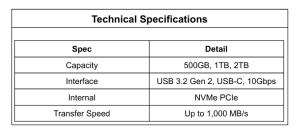
The Aegis NVX runs NVMe over PCIe internally and connects via USB 3.2 Gen 2 at 10 gigabits per second, with transfer speeds up to 1,000 megabytes per second. On a modern laptop with NVMe internal storage it moves like a fast external SSD, because that is essentially what it is, with a security architecture baked in underneath rather than layered on top as an afterthought. The performance penalty that used to be a legitimate objection in the hardware encryption debate is gone. You get the security benefit of a fast external SSD and more sleep knowing that the data is safe, secure, and encrypted.
Let’s Talk About The Price
While you might be thinking “It’s more expensive per gigabyte than a commodity SSD!” Yes. Yes, it is. Let’s take a look at that comparison and it collapses the moment you look at what you are actually putting side by side. A commodity SSD is a storage container for your data.
That’s it. The NVX is a security device that also stores data.
These are different tools that are solving different problems, and pricing them against each other is like pricing a safe against a cardboard box because both of them hold documents. The number that actually provides context here is the cost of a reportable breach. IBM’s Cost of a Data Breach report has put the global average north of $4 million per incident, with financial services running consistently higher than that average. Fines, notification requirements, legal fees, remediation costs, and the reputational fallout in industries where client trust is the entire foundation of the business relationship.
One unencrypted device with customer financial data going missing can cost millions by the time everything is tallied and the dust settles. The difference in encrypted vs not encrypted can be massive in that scenario. “The device was encrypted” is a complete defense in most regulatory frameworks governing portable data storage. “It was not encrypted” is the opening sentence of a very long and expensive conversation with regulators, attorneys, and eventually the press. When you look at those numbers, the $569 pricing is not worth debating. It is the least expensive part of the story by far. It’s not even close. The TAA compliance point deserves its own note for anyone in the room at Money2020 with government exposure. Federal procurement rules are not negotiable.
The NVX passes them all. For organizations that operate across both commercial and government-facing channels, that one qualification removes a category of procurement friction that otherwise requires maintaining two separate hardware standards indefinitely.
What to Know Going In
Before you make a purchasing decision here are a few things you should know:
This is a secure transport and storage device.
It is not a backup solution, so don’t treat it like one. Anything living on this drive should also exist somewhere else. If the crypto-erase runs from too many bad PIN attempts, that data is gone. No support call can fix it. No manufacturer recovery process. There is no getting it back. That is precisely what makes it useful in a compliance context, but it also means you treat it like what it is: a secure vault for data that lives in at least one other place, too. Hardware encryption does not cover the full threat surface and does not claim to.
Data moving from an unencrypted network connection is still exposed regardless of what drive it came from. An authorized user with the correct PIN can still make poor decisions once the drive is unlocked. Social engineering targeting the person holding the device is a completely separate problem that no encryption scheme addresses. The NVX solves specific architectural vulnerabilities very well, and it is very honest in its documentation about what it does and does not do. That’s refreshing in a market where products constantly overclaim what they can do.
Putting It All Together
The encryption architecture is the foundation.
Software encryption parks the decryption key in the host machine’s RAM while the drive is active. That means an attacker who gets into that machine can potentially get the key, too. Hardware encryption keeps it sealed inside the device the entire time, with no version of it ever touching the connected computer. It changes when an attacker would need to access the data from “get into the host machine” to “overcome hardware-level cryptography with no key to find.” The feature set that follows from that foundation is consistent in its logic. Every feature on this drive exists because someone asked a hard question during a security evaluation and needed a real answer. The Admin PIN architecture exists because enterprise IT cannot share admin credentials with every employee who touches a device. The crypto-erase exists because a seized drive should give an attacker absolutely nothing to work with, no matter how long they have it. The Self Destruct PIN exists because sometimes you cannot wait for a remote wipe command to reach the device. The read-only modes exist because forensic investigators and compliance teams need to handle data without any mechanical possibility of altering it. The secure firmware exists because the supply chain is now a documented attack surface, and hardware that can be silently modified before it reaches you cannot be trusted. None of these features were added because someone wanted to make the spec sheet look impressive. Each one is a direct answer to a question that comes up in real security and compliance conversations, and anyone who has sat in those meetings will recognize every single one of them immediately. The performance objection is gone, too. Earlier generations of hardware-encrypted drives ran on SATA and were genuinely slow. NVMe at 1,000 megabytes per second is not a security tax on your workflow. That argument no longer has a leg to stand on. What does stand up is the conversation happening at Money2020 this year in Las Vegas, in a room full of people whose organizations live and die by how well they protect the data they hold. That conversation is about trust.
It’s about what concrete, hardware-level steps you can take so that trust is not the only thing standing between your data and someone who wants it. Pick up an Aegis NVX and the weight tells you someone thought hard about those questions before they built it. You no longer have to choose between fast and secure. That tradeoff is gone.
Links
Apricorn: https://www.apricorn.com
Aegis NVX: https://www.apricorn.com/aegis-nvx
Kurt Markley, Director of Sales: kmarkley@apricorn.com