



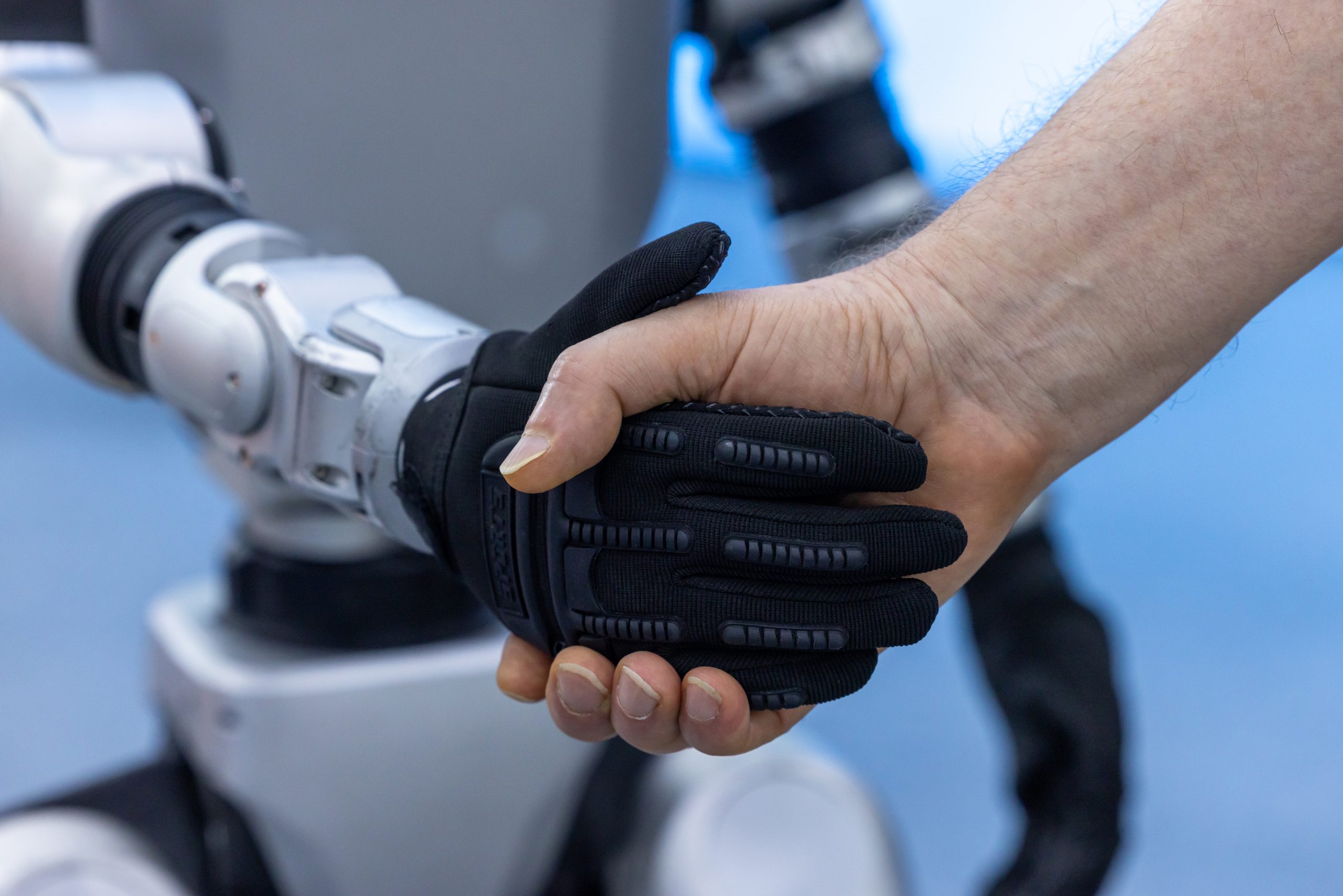
The robots arrived in Las Vegas, and they brought their builders with them. Throughout 2025, conferences across the city showcased a fundamental shift in how artificial intelligence moved from software algorithms into physical machines that work alongside humans.
CES 2026 in January set the tone. Nvidia, AMD, Intel, and Qualcomm all brought humanoid robots to demonstrate their chips powering autonomous systems. By December’s AWS re:Invent, the conversation had evolved from “can we build these?” to “how do we scale production?”
This wasn’t science fiction anymore. Companies were deploying robots in warehouses, factories, and retail environments. The Las Vegas conference circuit documented that transformation in real time.
The Chip Wars Go Physical
Nvidia’s Jensen Huang appeared at CES wearing his signature leather jacket and announced the Rubin AI supercomputing platform. But the real story wasn’t the chip specs. It was the cowboy hat-wearing humanoid robot demonstrating how those chips enable machines to navigate complex environments.
The company’s setup included a robot simulating surgery with precision most humans couldn’t match. Another helper bot assisted with check-in at Nvidia’s event, handling tasks that normally require human judgment.
AMD countered by bringing Generative Bionics CEO Daniele Pucci onstage to unveil the GENE.01 humanoid robot powered by AMD processing technologies. The machine walked, balanced, and manipulated objects using AMD’s compute platform.
Intel showcased Oversonic Robotics’ RoBee humanoid robot demonstrating how the company’s Core Ultra 3 processors handle real-time decision-making. The competition became clear. Chip manufacturers weren’t just selling components anymore. They were proving their silicon could power the next generation of autonomous systems.
Qualcomm joined the race with demonstrations of chips designed specifically for robotics applications. The company understood that mobile device processors provided useful starting points, but robots need different capabilities: real-time sensor fusion, motor control, and decision-making under power constraints.
Boston Dynamics Goes Commercial
The most significant announcement came from Boston Dynamics and Hyundai. After years of viral videos showing Atlas robots doing backflips and parkour, the companies announced plans for mass production.
Hyundai, which owns a majority stake in Boston Dynamics, will begin using Atlas robots in its factories starting in 2028. The partnership represents more than a pilot program. Hyundai is committing to developing a value chain for robot production at scale.
The decision matters because it proves the business case for humanoid robots. Hyundai wouldn’t invest in production infrastructure if the economics didn’t work. Factory deployment provides controlled environments where robots can prove value before expanding to more complex settings.
Boston Dynamics also partnered with Google DeepMind to integrate Gemini foundation models into Atlas robots. The combination brings Google’s AI capabilities to Boston Dynamics’ hardware platform, creating systems that can learn and adapt rather than just following programmed routines.
LG’s Robot Strategy Takes Shape
LG Electronics used its CES keynote to unveil CLOiD robots designed for commercial and residential use. The company has been developing robotics for years, but 2026 marked a shift to production-ready products.
The robots serve specific functions: delivery, cleaning, customer service, and companionship. LG focused on practical applications rather than general-purpose capabilities. A robot that does one thing reliably beats a robot that does everything poorly.
The Alpha 11 AI Processor Gen3 that powers LG’s latest TVs also handles robotics computation. The chip processes sensor data, makes navigation decisions, and coordinates with other smart home devices. LG is building an ecosystem where robots integrate seamlessly with other products.
Agility Robotics Enters the Conversation
Agility Robotics brought its Digit robot to multiple Las Vegas conferences throughout the year. The bipedal machine handles warehouse logistics, moving boxes and packages in environments designed for humans.
Amazon has been testing Digit in fulfillment centers, evaluating whether humanoid robots can supplement traditional automation. The early results suggest yes. Digit navigates spaces where wheeled robots struggle and handles irregular packages that confound specialized systems.
The company’s presence at Las Vegas conferences signaled confidence in commercialization. They weren’t seeking research partnerships. They were demonstrating products ready for deployment.
Physical AI Becomes the Framework
Arm, whose chip architecture powers most smartphones and increasingly dominates computing, framed the trend as “physical AI.” The term distinguishes systems that interact with the real world from software that operates purely in digital space.
Physical AI requires different capabilities than traditional computing. Sensors must gather environmental data. Processors must make split-second decisions. Actuators must execute movements precisely. Power consumption must stay manageable because robots can’t stay plugged in constantly.
Arm’s presence throughout Las Vegas conferences emphasized how chip architecture enables everything else. The company doesn’t build robots, but nearly every robot showcased in Las Vegas relied on Arm-based processors.
Rivian’s Autonomy Platform Goes In-House
Rivian used CES to announce its in-house autonomy platform running on custom chips built using the Arm compute platform. The company wants to control the full stack from hardware to software rather than relying on third-party systems.
The decision reflects a broader trend. Automotive companies are becoming technology companies. They’re hiring chip designers, AI researchers, and robotics engineers. The vertical integration lets them optimize systems end-to-end rather than assembling components from multiple suppliers.
Rivian’s platform will unlock advanced autonomy capabilities across future vehicles and other autonomous systems. The company sees robots and self-driving cars as related problems requiring similar technical solutions.
Tesla’s AI5 Chip Pushes Performance
Tesla announced its AI5 chip at CES, built on the Arm compute platform and delivering 40 times faster AI performance than the previous generation. The jump in capability matters because autonomous vehicles must process massive amounts of sensor data in real time.
Every camera, radar, and lidar sensor generates data that requires interpretation. The car must identify objects, predict their movements, plan safe paths, and execute maneuvers. Faster processing means better decisions and safer operation.
Tesla’s vertical integration approach mirrors Rivian’s strategy. The company designs its own chips, writes its own software, and manufactures its own vehicles. This control lets Tesla iterate quickly and optimize the full system.
The Robotics Startup Ecosystem
Beyond major corporations, dozens of robotics startups exhibited at Las Vegas conferences. These companies focused on specific applications: agriculture, healthcare, hospitality, security, and inspection.
The specialization makes sense. General-purpose robots remain difficult and expensive to build. Focused applications let startups prove value in narrow domains before expanding capabilities.
Investors paid attention. Funding for robotics companies increased throughout 2025 as investors saw real products reaching real customers. The conversation shifted from “will this work?” to “how fast can you scale?”
Quantum Computing Enters the Discussion
CES Foundry, held at Fontainebleau Las Vegas during CES, created dedicated space for quantum computing and AI discussions. D-Wave Quantum, IBM, Quantum Computing Inc., and SuperQ Quantum Computing Inc. all demonstrated systems and provided hands-on experiences.
Quantum computers won’t replace traditional processors, but they solve certain problems dramatically faster. Drug discovery, materials science, optimization problems, and cryptography all benefit from quantum approaches.
The connection to robotics isn’t obvious initially, but quantum systems could help train AI models more efficiently and solve complex planning problems that defeat classical computers. The technology remains experimental, but Las Vegas conferences gave attendees direct exposure to working systems.
Smart Assistants Get More Capable
Beyond humanoid robots, conferences showcased AI-powered assistants embedded in everyday devices. Amazon’s Alexa, Google Assistant, and other platforms demonstrated improved natural language understanding and better context awareness.
LG’s AI televisions use voice assistants to control smart home systems, find content, and answer questions. The integration feels seamless because the AI understands context rather than just matching keywords.
These incremental improvements matter as much as headline-grabbing robots. AI becomes truly useful when it disappears into devices people already use rather than requiring dedicated hardware.
Healthcare Applications Gain Traction
HLTH USA 2025, held in October at The Venetian Expo, focused specifically on healthcare innovation. Robotics applications in surgery, rehabilitation, elder care, and patient monitoring drew significant attention.
Surgical robots offer precision beyond human capability. Rehabilitation robots provide consistent therapy exercises. Elder care robots assist with daily activities while maintaining dignity. Patient monitoring systems detect problems early through continuous observation.
Healthcare robotics faces unique challenges. Regulatory approval takes years. Integration with existing hospital systems proves complex. Liability concerns slow adoption. But the potential benefits drive continued investment.
The Labor Question Nobody Wants to Answer
Throughout Las Vegas conferences, a question lingered unspoken in many sessions: what happens to human workers when robots become capable and economical?
Some presenters emphasized augmentation rather than replacement. Robots handle dangerous, repetitive, or physically demanding tasks, freeing humans for work requiring creativity, empathy, and judgment. This narrative feels comfortable.
Reality proves messier. Companies invest in automation to reduce labor costs. Robots don’t call in sick, don’t require benefits, and don’t unionize. The economic incentives point toward displacement, not just augmentation.
A few sessions addressed this directly, discussing retraining programs and new job categories. But most avoided the topic, focusing on technical capabilities rather than social implications.
Key Takeaways
The Las Vegas conference circuit in 2025 documented several clear trends in AI and robotics. First, the technology moved from research labs to commercial deployment. Companies aren’t building prototypes. They’re shipping products.
Second, chip manufacturers are racing to power the robotics revolution. The winner will supply millions of robots over the next decade. The stakes justify massive R&D investment.
Third, vertical integration is winning. Companies that control the full stack from chips to software to applications move faster and optimize better than those assembling components.
Fourth, specialization beats generalization. Robots that excel at specific tasks reach market faster than those attempting human-like versatility.
Fifth, the conversation about social impact lags behind technical development. The industry celebrates capabilities without seriously addressing consequences.
The Path Forward
Las Vegas will continue hosting robots at conferences. CES 2027, AWS re:Invent 2026, and other major events will showcase improved capabilities and broader deployments.
Questions remain about adoption timelines, cost curves, and social acceptance. Technical feasibility doesn’t guarantee market success. Robots must prove reliable, economical, and valuable enough to justify investment.
But the direction is clear. Physical AI is real, commercial deployment is happening, and Las Vegas conferences provide the platform where companies demonstrate progress to customers, partners, and investors.
The robots came to Las Vegas and made their case. Now they need to prove themselves in warehouses, factories, hospitals, and homes. The next year will determine whether the promises showcased in conference demos translate to business results that matter.
Links:
– CES 2026 Physical AI Coverage: engadget.com
– Arm’s CES 2026 Trends: newsroom.arm.com
– AI and Robotics at CES: finance.yahoo.com
– AWS re:Invent AI Announcements: aws.amazon.com