



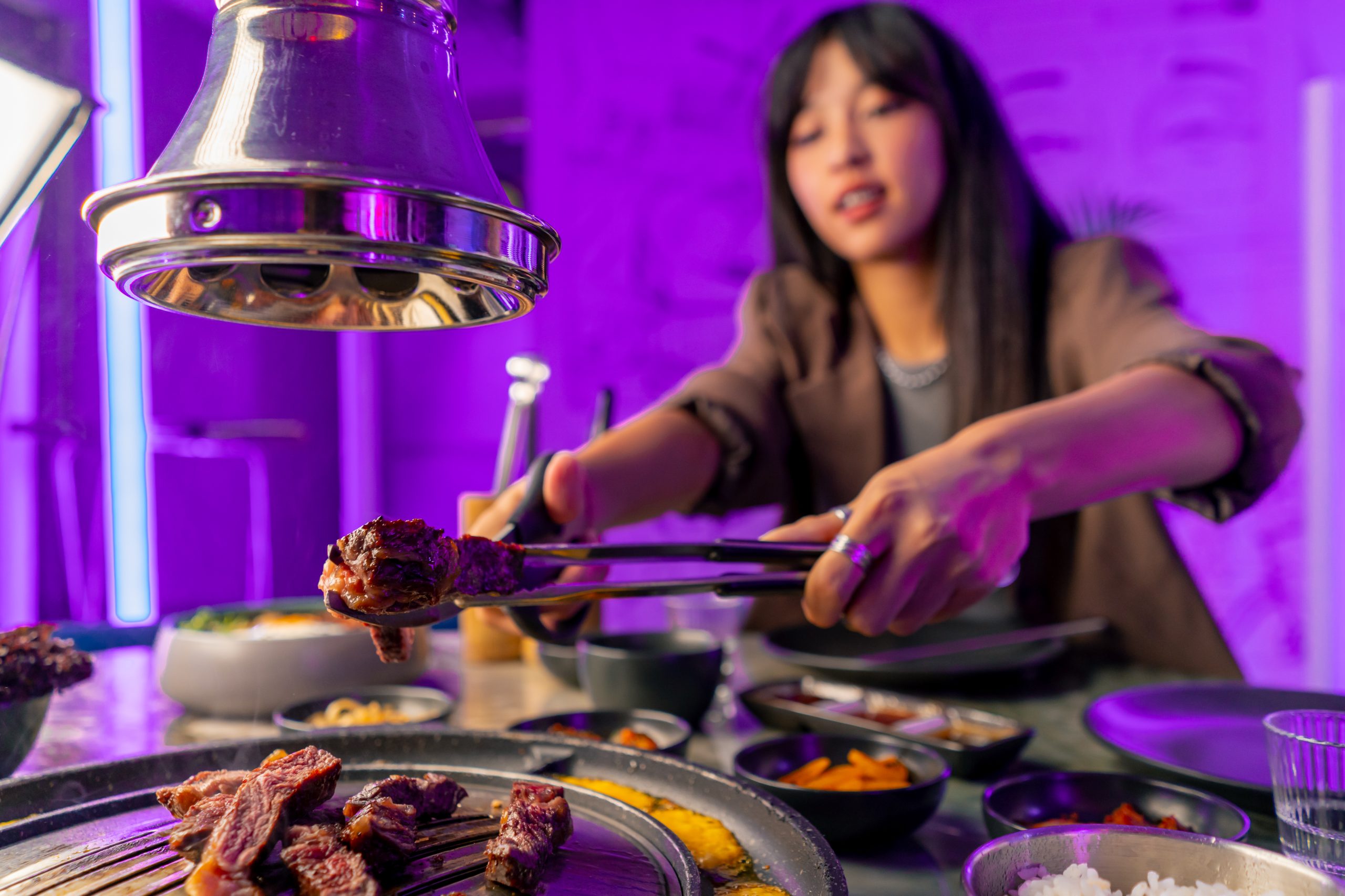
When COTE opened at The Venetian in late 2024, it brought something Las Vegas had never seen before: a Korean steakhouse with a Michelin star. Not a Korean restaurant that happens to serve good meat. Not a steakhouse with Asian influences. A genuine hybrid that takes the best elements of both traditions and merges them into something entirely its own.
The concept sounds simple enough. Guests sit at tables equipped with smokeless grills. Servers bring premium cuts of beef, from dry-aged American steaks to A5 wagyu from Kobe, Sendai, and Miyazaki. The meat cooks tableside while diners enjoy it Korean BBQ style, wrapped in lettuce with banchan and sauces. But this description misses what makes COTE significant. This restaurant is performing surgery on two well-established dining categories, extracting the most valuable elements from each, and creating something that challenges assumptions about what premium dining can look like in Las Vegas.
The Steakhouse Problem
Las Vegas has a steakhouse problem, though it’s not the kind of problem most cities would complain about. The Strip is saturated with excellent steakhouses. SW Steakhouse at Wynn. CUT by Wolfgang Puck at The Palazzo. Prime at Bellagio. Bazaar Meat, which just relocated from Sahara to The Venetian. The list goes on, each offering minor variations on the same basic formula: white tablecloths, extensive wine lists, perfectly cooked beef, sides that cost extra, checks that run well into three figures.
For years, this model worked beautifully. Steakhouses generated enormous revenue per square foot. They attracted high rollers and expense account diners. They provided the kind of luxury experience that justified Vegas price points. But the market has shifted. The summer 2025 tourism dip revealed that even affluent visitors have limits on what they’ll spend for familiar experiences. When every major casino has a premium steakhouse, how do you convince diners that yours deserves their money?
COTE’s answer is to stop playing the traditional steakhouse game entirely. Yes, they serve exceptional beef. Yes, the prices reflect premium positioning. But the experience feels fundamentally different from what neighboring steakhouses offer. The tableside grilling isn’t a gimmick. It’s central to the concept, transforming a passive dining experience into an active one. Guests don’t just eat the steak. They participate in its preparation, guided by servers who manage the grill with precision.
This participation changes the value equation. Diners aren’t just paying for beef. They’re paying for an experience they can’t replicate at home, even if they could source the same quality wagyu. The Korean BBQ format, which in other contexts might feel casual or even budget-friendly, becomes elevated when applied to cuts that would command premium prices in any high-end steakhouse.
The Korean Food Ceiling
COTE also solves a problem for Korean cuisine, though it’s a problem that operates in the opposite direction. Korean BBQ restaurants exist throughout Las Vegas, particularly in the Chinatown corridor. Many serve excellent food. Some offer all-you-can-eat formats that provide tremendous value. But with rare exceptions, these restaurants struggle to command the same price points or occupy the same prestige positions as top-tier Japanese, French, or Italian establishments.
This isn’t about quality. Korean cuisine is technically complex, flavor-balanced, and deeply sophisticated. The issue is positioning and context. When Korean BBQ is associated primarily with casual dining and all-you-can-eat specials, it becomes difficult for even exceptional Korean restaurants to charge prices that reflect the skill and ingredients involved in proper execution.
COTE breaks through this ceiling by refusing to accept it in the first place. The restaurant operates in The Venetian, one of the Strip’s most prestigious properties. The dining room design suggests luxury without being overly formal. The service style matches what diners expect at high-end establishments. And crucially, the prices reflect the quality of the ingredients and the skill of the preparation.
By positioning Korean BBQ as worthy of the same premium treatment as French or Japanese cuisine, COTE creates permission for other Korean concepts to raise their ambitions. If Korean BBQ can earn a Michelin star in New York and then successfully expand to Las Vegas at luxury price points, it validates the entire category in ways that a hundred excellent but modestly priced Korean restaurants could not.
The Michelin Star Advantage
The Michelin star COTE earned in New York provides enormous leverage in Las Vegas. Michelin only started reviewing Las Vegas restaurants in recent years, and the guide’s influence on dining decisions has grown accordingly. When visitors research where to eat on the Strip, Michelin stars carry weight that reviews and social media buzz cannot match.
But the star does more than drive reservations. It provides cover for premium pricing and justifies the restaurant’s presence among The Venetian’s other high-profile dining options. Without that Michelin credential, COTE might be perceived as an interesting concept that doesn’t quite belong in the same conversation as, say, Bazaar Meat or other established Strip steakhouses. With the star, those comparisons become not just valid but expected.
This matters particularly given The Venetian’s recent expansion and renovation. The property has been aggressive about upgrading its dining portfolio, bringing in concepts like Gjelina from Venice Beach and investing in the Via Via food hall. COTE fits perfectly into this strategy of offering diverse, high-quality dining options that give guests reasons to stay on property rather than exploring competitors.
The Service Challenge
Operating a Korean BBQ restaurant at Michelin-star standards creates unique service demands. Servers need to master tableside grilling while maintaining the polish and knowledge expected at premium establishments. They need to explain unfamiliar dishes and ingredients to guests who might be experiencing proper Korean BBQ for the first time. And they need to manage the pacing of a meal that unfolds differently from traditional steakhouse service.
Consider the complexity involved. A server at COTE must know how to cook different cuts of wagyu to proper temperature on the tableside grill. They need to understand the provenance of beef from Kobe versus Sendai versus Miyazaki and be able to explain those differences to curious diners. They must coordinate the arrival of banchan and accompaniments so they’re available when needed but don’t crowd the table. And they have to do all this while maintaining the kind of seamless, anticipatory service that high-end dining demands.
This level of service doesn’t happen by accident. It requires extensive training, careful hiring, and operational systems that support consistency even during busy periods. The restaurant must strike a balance between Korean BBQ’s inherently casual, convivial nature and the elevated service standards that Vegas diners expect when paying premium prices.
Get this balance wrong and the concept fails. Too casual and diners feel like they’re overpaying for a dressed-up Korean BBQ experience they could get elsewhere for less money. Too formal and the restaurant loses the participatory, social element that makes Korean BBQ distinctive in the first place.
Market Timing and Competition
COTE’s expansion to Las Vegas comes at an interesting moment for the city’s dining scene. The summer 2025 tourism dip forced many operators to reconsider their strategies. Some responded with value packages and promotions. Others doubled down on premium experiences, betting that while overall visitor numbers might be down, visitors who do come still want exceptional dining options.
COTE falls squarely in the second camp. This isn’t a restaurant trying to compete on price or volume. It’s competing on uniqueness and quality, assuming that enough diners exist who will pay premium prices for an experience they can’t get elsewhere.
The competitive landscape supports this assumption, but only to a point. Las Vegas has numerous excellent steakhouses, but COTE offers something genuinely different. The city has good Korean restaurants, but none operating at this level or price point on the Strip. The concept occupies a unique position in the market.
However, uniqueness alone doesn’t guarantee success. The restaurant still needs to convince diners that the experience justifies the cost, particularly when those diners have many other excellent options within walking distance. A party of four can easily spend $800 or more at COTE. For that same money, they could dine at any number of celebrated Strip restaurants. Why choose Korean BBQ?
The Answer in the Experience
COTE’s response to this question lives in the dining experience itself. The smokeless grills create theater without feeling contrived. The procession of different beef cuts, each with distinct flavor profiles and textures, provides variety within the meal that static steakhouse offerings can’t match. The Korean accompaniments and preparations introduce complexity and contrast that make the beef more interesting rather than simply different.
Most importantly, the format encourages sharing and interaction. Diners aren’t just sitting across from each other eating individual steaks. They’re participating in a communal experience, trying different cuts, discussing preferences, building lettuce wraps together. This social dimension adds value that’s difficult to quantify but easy to feel.
For Las Vegas visitors, this social element matters enormously. Groups dining together want experiences that facilitate conversation and shared enjoyment. The COTE format delivers exactly that, making it particularly appealing for celebrations, business dinners, or friend groups looking for something more engaging than traditional fine dining.
Notes and Key Takeaways
For Restaurant Operators:
COTE demonstrates that category innovation doesn’t require inventing entirely new concepts. Sometimes the opportunity lies in taking established formats from different traditions and combining them in ways that create new value propositions. The key is execution at a level that justifies premium positioning.
For Diners:
COTE offers an experience that’s genuinely different from both traditional steakhouses and casual Korean BBQ restaurants. The premium pricing reflects not just ingredient quality but the skill required to execute this hybrid concept at Michelin-star standards. Diners should approach it as its own category rather than comparing it directly to either steakhouses or Korean restaurants.
For Las Vegas:
The success of concepts like COTE, which bring Michelin credentials to underrepresented cuisines, signals a maturing dining market. Vegas is moving beyond simply importing celebrity chefs and famous restaurant names to embracing concepts that challenge category definitions and expand what premium dining can look like.
Important Insights:
The Venetian’s decision to bring in COTE reflects a broader strategy of differentiating through diversity rather than simply stacking up more traditional premium options. As competition for tourist dollars intensifies, properties need dining portfolios that offer varied experiences rather than variations on the same experience.
COTE’s tableside grilling format addresses a challenge that many high-end restaurants face in the age of social media and experiential dining. Guests want more than just excellent food. They want experiences worth sharing and remembering. The interactive element of Korean BBQ provides exactly that kind of memorable, shareable moment.
The restaurant’s success or struggle will indicate whether Las Vegas diners are ready to embrace premium pricing for cuisines traditionally associated with more casual dining. If COTE thrives, expect to see other operators testing similar category-breaking concepts.
The timing of COTE’s arrival, during a period when Vegas is reassessing value propositions across the board, creates both opportunity and risk. The restaurant can either prove that unique, high-quality experiences still command premium prices regardless of economic headwinds, or it can become a cautionary tale about misreading market conditions. Either outcome will provide valuable lessons for the industry.