

George Pappas did not set out to manufacture LED displays. He set out to install them.
When Pappas founded i5LED in Sacramento, California, the plan was integration work: sourcing display technology built by someone else, delivering it to clients who needed large-format LED solutions, and making money on the service layer. This is how most of the industry operates. You buy panels from manufacturers in Shenzhen, mark them up, add labor, ship the finished product. The capital requirements stay low. The risks stay manageable.
The problem was the clients.
When you sell custom display solutions to clients who have genuinely unusual requirements, which is what i5LED was doing from the beginning, you keep running into a wall. The standard panel, built for standard applications, does not do what the client needs. The manufacturer cannot deviate from the standard build without minimum order quantities that make the project economics collapse. The timeline to get a custom specification manufactured overseas adds months to project schedules. And when something goes wrong with the installation, the service chain between the client and the person who actually built the panel has too many links.
After enough of those experiences, Pappas made a decision that was either visionary or reckless depending on how it turned out. He decided to build vertically.
What Vertical Integration Actually Means
Vertical integration is a phrase that appears in business school curricula and then gets diluted in practice to mean almost anything. A company that owns two links of a supply chain calls itself vertically integrated. A retailer that makes some of its own private label products does the same.
i5LED’s version is more thoroughgoing. The company operates three manufacturing facilities, in Taiwan, Malaysia, and China. It employs its own engineering teams who design panels from the circuit board up. It writes its own software for content management, playback control, and system diagnostics. It runs its own installation crews rather than subcontracting. And it maintains service relationships with clients long after the initial installation, sometimes across multi-year agreements that cover everything from routine maintenance to emergency response.
This is what it looks like when a company decides to control every variable that affects the client’s experience. The engineering team that designs the panel works in the same organization as the installation team that puts it up and the service team that answers the phone when something goes wrong at midnight before a major event. Information flows across those functions without the friction that separate organizations introduce. When a problem surfaces in the field, the feedback reaches the engineers who can actually fix it in the next product generation.
For clients with standard needs, this structure is overkill. You do not need a bespoke manufacturing operation to put a standard display in a conference room. The commodity market handles that efficiently.
But i5LED is not competing for standard needs.
The Three-Tier Market and Why Tier Three Is the Only One Worth Owning
The LED display industry segments into three tiers.
Tier One is the commodity market. Off-the-shelf panels, standardized specifications, price competition. The manufacturers who win here operate at scale so large that their cost advantages are essentially permanent. You cannot beat them on price. Any company trying to compete in Tier One against the established Asian manufacturers is making a strategic error that will become obvious when the margins compress to zero.
Tier Two is mid-market customization: modified standard products, some specification flexibility, faster lead times than Tier One manufacturers but with structural limits on how far the customization can go. Competitive but more defensible than Tier One because service relationships and faster turnaround create switching costs.
Tier Three is what the display industry informally calls bespoke and impossible. This is the segment where clients come to you with requirements that do not fit any existing product. A display surface that wraps around a curved architectural element. A panel with sub-two-millimeter pixel pitch that delivers broadcast-quality color accuracy. A system where the display and the structure it is embedded in need to be engineered as a single unit because the mechanical and optical requirements cannot be decoupled.
Tier Three clients are not shopping on price. They are shopping on capability. Can you actually do this? Very few companies can. The ones that can occupy a market position that does not compress the way commodity markets do, because the thing they offer cannot be replicated by throwing more capital at standard manufacturing.
i5LED decided, deliberately, to be a Tier Three company.
The COB Flexible Display and What It Proves
In April 2025, i5LED took home Best of Show at ISE, the Integrated Systems Europe trade show held in Barcelona. ISE is the largest AV trade show in Europe, and Best of Show is its most significant recognition.
The winning product was the company’s COB Flexible LED Display: a panel that bends to concave, convex, and cylindrical configurations with a 1.5-millimeter pixel pitch, 95 percent DCI-P3 color accuracy, and HDR10 support.
DCI-P3 is the color standard used in cinema projection. 95 percent coverage of that gamut means the display reproduces colors that most LED panels cannot produce at all. HDR10 support means the full range from near-black to bright white, at a level of dynamic range that consumer televisions advertise as a premium feature but that is genuinely unusual in commercial display applications.
The flexible substrate, the physical mechanism that allows the panel to curve without breaking the LED connections, is the part that most manufacturers cannot do at the pitch and color accuracy that i5LED delivers. The physics of bending a display without introducing dead zones, light leakage, or color shift across the curve are genuinely difficult. Solving them requires both the engineering capability to design it and the manufacturing precision to build it consistently.
You cannot source this product from a catalog. You cannot source it from most custom manufacturers either, because the combination of requirements, flexible substrate, sub-two-millimeter pitch, cinema-grade color, HDR, reliable mechanical stability across the bend radius, places it outside the production envelope of most facilities.
i5LED can build it because the same organization that designed it also built and operates the manufacturing lines that produce it.
The Cardone Ventures Project: What Scale Looks Like
The clearest case study in what i5LED’s model enables is the display system built for Cardone Ventures’ training facility in Scottsdale, Arizona.
Cardone Ventures runs training events for business owners and entrepreneurs. At scale, these events involve audiences of several hundred to several thousand people in a large-format theatrical environment. The visual experience matters, not as decoration but as content delivery: the display is the medium through which instruction, data, and demonstration reach the audience.
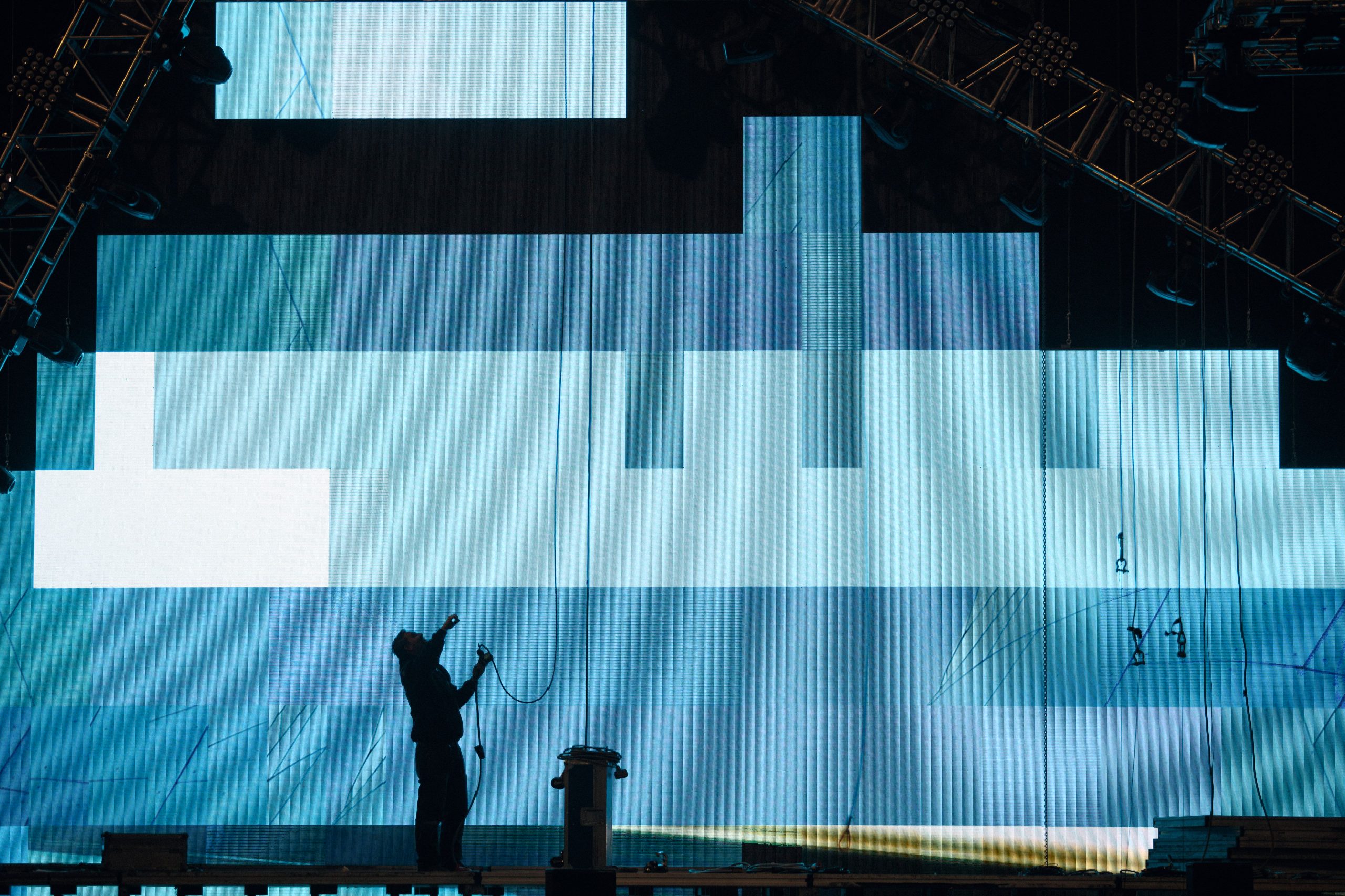
The system i5LED designed and installed for the Scottsdale facility runs 67 feet wide, covering 1,100 square feet of display surface with more than 60 million pixels.
Sixty million pixels is a number that requires some context. A 4K display has approximately 8.3 million pixels. The Cardone system delivers more than seven times that pixel count across its full surface. At the distances from which an audience views it, this means the display appears continuous and photorealistic regardless of the viewing angle or the proximity of the closest seats.
This was not a product installation. It was an engineering project. The structural requirements for mounting a 1,100-square-foot display, the power and data infrastructure to drive 60 million pixels reliably across a live event schedule, the calibration of color and brightness across a surface that large, and the integration with the facility’s other systems all required the full span of i5LED’s capabilities. Engineering, manufacturing, custom software, and installation all had to work as a single coordinated system.
The result is a display that functions as intended for every event, at a scale and quality level that the client could not have achieved with a standard product.
The Economics of Doing What Others Cannot
A common misunderstanding about premium positioning is that it simply means charging more for the same thing. The better version is: it means doing something that commands premium pricing because the alternative is not doing it at all.
i5LED’s clients in the Tier Three segment are not choosing between i5LED and a cheaper competitor offering equivalent capabilities. They are choosing between i5LED and not having the display solution they need. That market position looks different from the outside than pure pricing power does. It is not that the company charges more. It is that the company can do things the client cannot get elsewhere, which makes price comparisons structurally irrelevant.
This position requires continuous investment to maintain. The engineering team has to stay ahead of what clients will need next. The manufacturing facilities have to develop processes that maintain quality at the precision levels Tier Three clients require. The software has to integrate with whatever systems clients are already running. The service infrastructure has to be reliable enough that clients can build their live event schedules around a display system and trust it will work.
None of that is cheap. All of it is what keeps the position defensible.
Pappas built this over 25 years. The company is not a startup discovering vertical integration as a growth strategy. It is a mature organization that has spent a quarter century developing the specific capabilities that its market position requires, iterating on failures, investing in facilities and talent, and declining the simpler business of competing on price in segments where the margins do not justify the complexity.
The ISE Best of Show award in 2025 is one kind of validation. The 67-foot display running reliably through Cardone Ventures’ event schedule is another. Both point to the same underlying fact: the company built something that works, and the path to building it was not the easiest available path.
It was the one that required doing everything themselves.
Key Takeaways
- i5LED, founded by George Pappas and based in Sacramento, California, operates three manufacturing facilities across Taiwan, Malaysia, and China with full vertical integration spanning engineering, manufacturing, custom software, installation, and long-term service.
- The company deliberately competes in the “Tier Three: Bespoke and Impossible” segment of the LED display market, where client requirements exceed the production envelope of standard manufacturers.
- Its COB Flexible LED Display won Best of Show at ISE 2025, Europe’s largest AV trade show, with a 1.5mm pixel pitch, 95 percent DCI-P3 color accuracy, and HDR10 support on a substrate that bends to concave, convex, and cylindrical configurations.
- The company’s Cardone Ventures installation in Scottsdale, Arizona runs 67 feet wide across 1,100 square feet with more than 60 million pixels, requiring coordinated engineering, manufacturing, software, and installation capabilities unavailable from any single-function vendor.
- i5LED’s market position is defensible because clients choosing the company are often choosing between it and not having the solution they need, rather than comparing it to cheaper alternatives with equivalent capabilities.
Important Insights
Vertical integration is most valuable in exactly the market segments where standard supply chains fail most visibly. In commodity markets, vertical integration usually destroys value because it replicates at high cost what the market provides efficiently. In bespoke markets, it creates value by giving a single organization the full span of capabilities needed to solve problems that exceed any single function’s scope.
The 25-year timeline of i5LED’s development matters. The capabilities the company now offers could not have been assembled quickly. Manufacturing precision, engineering judgment about what is actually possible at what cost, software maturity, service reliability: each of these develops through iteration, not acquisition. Companies that try to buy their way into Tier Three often discover that the capabilities they bought do not integrate with each other the way 25 years of building together produces.
The Best of Show recognition at ISE tells a particular kind of story. Trade show awards at major industry events are chosen by practitioners who know what the actual competition looks like. A best-in-show recognition from the largest AV trade show in Europe for a flexible display product is a signal from the industry’s own experts that what i5LED built is not incrementally better than what others offer. It is categorically different. That distinction, between incremental improvement and categorical difference, is where genuine competitive advantage actually lives.
More information about i5LED’s display solutions and capabilities is available at i5led.com.